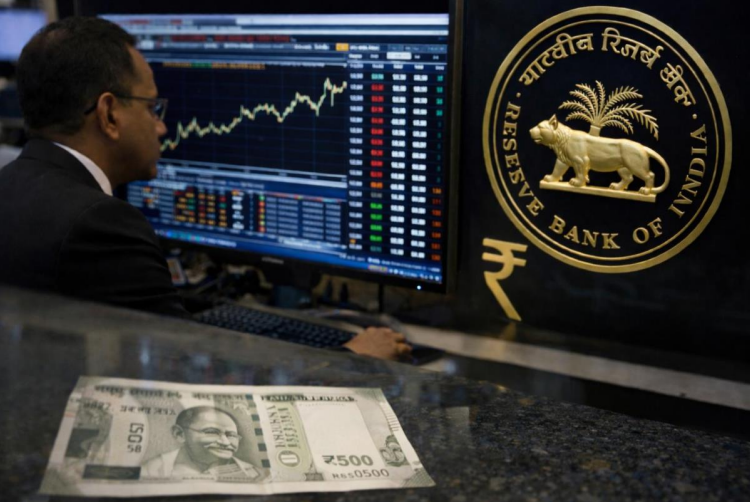
India’s financial markets experienced significant turbulence after the Indian rupee slid to a historic low against the U.S. dollar, prompting the Reserve Bank of India (RBI) to intervene decisively in currency markets to contain excessive volatility. During trading earlier this week, the rupee weakened to around ₹92.30 per dollar, marking its weakest level on record. The fall came amid global financial uncertainty, higher crude oil prices and strong demand for the U.S. dollar as investors moved toward safer assets during geopolitical instability.
The RBI quickly stepped in through state-owned banks by selling dollars in the market to stabilise the currency. Following the intervention, the rupee recovered and strengthened to around ₹91.6 per dollar by the close of trading, registering its strongest single-day recovery in nearly a month. Market participants said the central bank’s actions helped calm panic selling and restore liquidity in the foreign exchange market.
The rupee’s weakness reflects broader pressures facing emerging market currencies in a period of global uncertainty. Rising crude oil prices, geopolitical tensions in West Asia, and shifting global capital flows have intensified volatility across currency markets. For India, which imports roughly 85% of its crude oil requirement, fluctuations in energy prices can rapidly influence the exchange rate, inflation outlook and trade balance.
Rupee Slides to Record Low Amid Global Pressures
The rupee’s sharp fall was triggered by a combination of global economic and geopolitical factors. As tensions intensified in the Middle East and energy markets reacted to potential supply disruptions, crude oil prices rose sharply, pushing the U.S. dollar higher against most major currencies. This surge in the dollar placed heavy pressure on emerging-market currencies, including the Indian rupee.
During the trading session, the rupee breached the ₹92 per dollar mark for the first time, touching an all-time low of about ₹92.30 before stabilising. Currency traders reported heavy dollar demand from oil importers and foreign investors, which added to downward pressure on the domestic currency.
Analysts say the rupee’s decline also reflected broader global financial trends. The U.S. dollar index, which measures the greenback against a basket of major currencies, strengthened as investors sought safe-haven assets amid global uncertainty. Such movements typically weaken emerging-market currencies as capital flows shift toward developed economies.
According to Anindya Banerjee, Head of Currency and Commodity Research at Kotak Securities, the rupee’s fall was largely linked to rising oil prices and external geopolitical tensions rather than domestic economic weakness. He noted that when crude prices rise sharply, oil-importing countries like India tend to face greater pressure on their currencies because of higher import bills.
RBI’s Intervention Strategy in Currency Markets
In response to the rupee’s rapid decline, the Reserve Bank of India intervened aggressively in the foreign exchange market. The central bank sold U.S. dollars through state-run banks to increase dollar supply and prevent excessive depreciation of the domestic currency.
Market estimates suggest that the RBI may have sold several billion dollars possibly between $5 billion and $7 billion during the intervention, though the central bank does not publicly disclose the exact amount. Such actions are typically aimed at smoothing volatility rather than targeting a particular exchange rate.
India’s strong foreign exchange reserves provide the RBI with considerable flexibility to manage currency shocks. As of early 2026, the country’s reserves remained above $620 billion, giving policymakers sufficient resources to intervene when market conditions become disorderly.
The RBI has consistently emphasised that it does not seek to fix the rupee at any specific level. Instead, the central bank’s policy approach focuses on ensuring that currency movements remain orderly and reflective of economic fundamentals. By intervening during periods of extreme volatility, the RBI aims to maintain stability in financial markets while preserving investor confidence.
Oil Prices and Geopolitics Driving Currency Volatility
A major driver of the rupee’s recent weakness has been the sharp rise in global crude oil prices. Energy markets have become increasingly volatile due to geopolitical tensions in the Middle East, particularly concerns that disruptions could affect oil shipments through critical maritime routes such as the Strait of Hormuz, which handles nearly 20% of global oil trade.
Brent crude prices rose significantly during the week, approaching levels that analysts warn could place pressure on oil-importing economies. For India, which relies heavily on imported energy, higher oil prices directly increase the country’s import bill and widen the trade deficit.
When crude prices rise, Indian oil companies require more dollars to pay for imports, increasing demand for foreign currency in the domestic market. This additional demand for dollars weakens the rupee unless offset by strong capital inflows or central bank intervention.
Economists have warned that sustained crude prices above $90–$95 per barrel could affect India’s economic outlook by increasing inflation and widening the current account deficit. Higher fuel costs often filter through the economy by raising transportation expenses, manufacturing costs and consumer prices.
In addition to energy prices, geopolitical tensions have also increased global financial market volatility. Investors tend to shift funds into safe-haven assets such as U.S. Treasury bonds and the dollar during periods of uncertainty, which can place further pressure on emerging-market currencies.
Market Reaction and Financial Sector Impact
The RBI’s intervention had an immediate impact on financial markets. After touching record lows earlier in the session, the rupee rebounded strongly, gaining nearly 0.6% against the dollar and closing around ₹91.6, its best daily performance in several weeks.
The recovery helped restore stability in domestic currency markets and eased concerns among investors about the pace of the rupee’s decline. Equity markets also responded positively, with banking and financial stocks benefiting from improved currency sentiment.
Currency traders noted that the RBI’s strategy of intervening during periods of relatively thin market liquidity particularly early in the trading session can have a strong psychological effect on market participants. By demonstrating its willingness to act decisively, the central bank can discourage speculative positions against the rupee.
However, analysts caution that currency interventions typically provide only temporary relief if underlying global pressures remain strong. Factors such as oil prices, foreign investment flows and global interest-rate movements will continue to influence the rupee’s trajectory.
Despite these challenges, many economists believe India’s macroeconomic fundamentals remain relatively strong. The country’s foreign exchange reserves, stable banking system and steady economic growth provide important buffers against external shocks.
Outlook
The recent rupee volatility illustrates the complex challenges facing emerging economies in an increasingly uncertain global environment. While external shocks such as geopolitical tensions and commodity price surges can trigger sudden currency movements, policymakers must carefully balance market forces with the need to maintain financial stability.
The Reserve Bank of India has repeatedly emphasised that its interventions are aimed at preventing excessive volatility rather than controlling the long-term direction of the exchange rate. By maintaining a flexible exchange-rate regime supported by strong reserves, the central bank seeks to ensure that currency movements remain orderly and aligned with economic fundamentals.
Looking ahead, the rupee’s performance will depend largely on global factors, particularly energy prices, geopolitical developments and international capital flows. If crude prices stabilise and investor sentiment improves, the pressure on the rupee could ease in the coming months.
For India, the episode underscores the importance of strengthening economic resilience through diversified energy sources, stable macroeconomic policies and continued growth in exports and investment. As global financial conditions evolve, maintaining stability in the currency market will remain a key priority for policymakers navigating the challenges of an interconnected global economy.