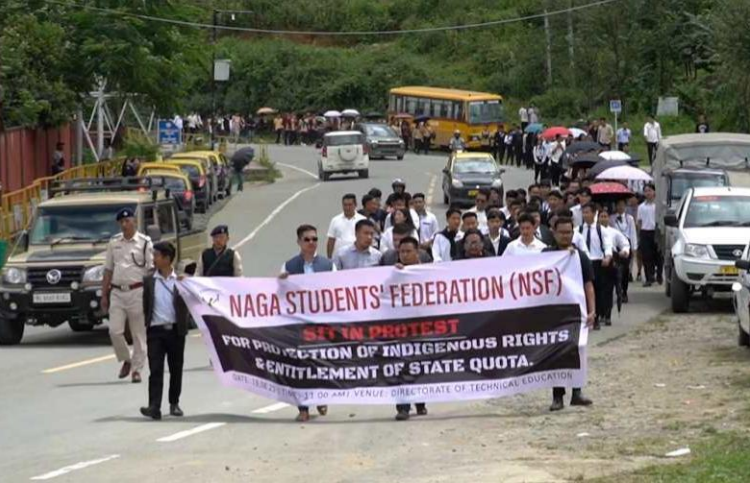
A political and cultural debate has intensified in India’s northeastern region after the Naga Students’ Federation announced a protest rally opposing what it describes as the “imposition” of the national song Vande Mataram in educational and public institutions across Nagaland.
The rally, scheduled in March 2026, is being organised by the influential student body to express concerns over cultural autonomy, religious sensitivities, and constitutional safeguards specific to the state. The issue has quickly evolved into a wider national discussion about the balance between national symbolism and regional identity in India’s diverse federal structure.
The controversy traces its roots to a directive linked to national ceremonial practices that encourages the playing or singing of Vande Mataram during official functions and educational programmes alongside the national anthem.
Several political leaders, student groups, and civil society organisations in Nagaland argue that such directives may conflict with the unique socio-cultural landscape of the state, where the majority of the population belongs to Christian denominations and where special constitutional protections exist for local customs and traditions.
While the issue may appear symbolic, it has gained significance because of the broader historical and constitutional context of the region. Nagaland enjoys special protections under Article 371(A) of the Indian Constitution, which safeguards the state’s religious and social practices, customary laws, and land rights.
Student organisations argue that any centrally guided symbolic mandate must take these provisions into account, making the debate both a constitutional and cultural matter.
Directive Sparks Cultural and Constitutional Concerns
The dispute gained momentum after discussions in Nagaland’s legislative and educational circles about incorporating Vande Mataram in official programmes.
Reports indicated that some government institutions had begun playing the national song during formal events, sometimes before the national anthem, following guidance linked to broader national ceremonial practices. This move triggered objections from student bodies and local leaders who felt the decision had been implemented without adequate consultation with regional stakeholders.
The Naga Students’ Federation issued statements warning against attempts to institutionalise the song in schools, universities, or public administrative institutions.
Federation leaders argued that the directive failed to recognise the distinct cultural and religious context of Nagaland, where identity, faith, and local traditions hold strong influence over public life.
According to the organisation, introducing such symbolic practices without dialogue risks creating tension between national institutions and regional communities.
Student leaders further emphasised that the federation does not oppose the national anthem or the Indian constitutional framework but objects to what it sees as cultural enforcement.
They argued that the issue should not be interpreted as anti-national sentiment, but rather as a demand for respecting the unique socio-political realities of the Naga people.
Such concerns reflect a long-standing debate in India’s northeastern states about how national policies intersect with local identity and autonomy.
Student Organisations Lead Regional Protest Movement
The planned rally marks one of the most visible student-led mobilisations in Nagaland in recent months.
The Naga Students’ Federation has called upon its federating units and affiliated student bodies across districts to participate in the demonstration.
The rally aims to send a clear message to authorities that educational institutions and public forums in the state should not be compelled to adopt cultural practices perceived as inconsistent with local traditions.
Student leaders have framed the movement as part of a broader struggle to protect indigenous identity in the Northeast.
They argue that the region’s unique history—including decades of political negotiations, cultural preservation efforts, and constitutional protections—requires sensitive handling of national directives.
Protest organisers have also emphasised that their mobilisation will remain peaceful and democratic, focusing on dialogue rather than confrontation.
The protest has gained support from several civil society groups and church organisations in the state.
Religious leaders have echoed the students’ concerns, stating that cultural symbols associated with specific historical narratives may not resonate with communities whose faith traditions differ significantly from those referenced in the national song’s imagery.
Such alliances between student bodies and community organisations have amplified the visibility of the issue across the region.
Political Leaders and Institutions Respond
Political reactions to the controversy have been varied.
Leaders from regional parties in Nagaland have expressed concern that any directive perceived as compulsory could undermine the constitutional protections granted under Article 371(A).
Some lawmakers have suggested that the matter should be reviewed by legislative committees to ensure that national ceremonial practices do not conflict with the state’s special constitutional status.
Nagaland Chief Minister Neiphiu Rio indicated that the issue may be examined through a consultative process involving legislators, community leaders, and student organisations.
This approach, he suggested, would help prevent misunderstandings and ensure that national policies are implemented in ways that respect the cultural and historical realities of the region.
At the national level, officials have emphasised that Vande Mataram remains an important historical symbol associated with India’s freedom movement.
However, legal experts note that the national song does not carry the same constitutional obligations as the national anthem.
This distinction has added another dimension to the debate, with scholars pointing out that the issue lies less in legality and more in the interpretation of cultural sensitivity within a diverse federation.
Wider Debate on National Identity and Federal Diversity
The controversy in Nagaland has also reignited a broader national conversation about how symbols of patriotism are interpreted in multicultural societies.
India’s northeastern region is home to hundreds of ethnic groups and languages, many of which maintain distinct cultural and religious identities that differ from those of the country’s majority population.
Policymakers and scholars argue that this diversity is one of India’s greatest strengths, but also requires careful negotiation when implementing national initiatives.
Observers note that similar debates have surfaced in other parts of the Northeast, including neighbouring Meghalaya, where legislators and civic groups have also raised concerns about mandatory cultural practices.
These discussions highlight the challenge of balancing national integration with respect for regional autonomy.
Analysts say the situation underscores the importance of dialogue between central authorities and local communities when dealing with symbolic issues.
For many residents of the region, the controversy is not merely about a song but about the broader principle of self-determination within India’s federal structure.
Civil society groups argue that ensuring mutual respect between national institutions and regional communities will be essential for maintaining social harmony and political stability in the Northeast.
Conclusion
The planned rally by the Naga Students’ Federation has transformed a symbolic dispute into a significant national conversation about cultural autonomy, constitutional protections, and the meaning of national identity in a diverse democracy.
While the protest reflects genuine concerns among student groups and local organisations, political leaders have indicated that dialogue and consultation may provide a path toward resolving the issue without deepening divisions.
As India continues to navigate questions of identity and unity across its vast cultural landscape, the Nagaland controversy serves as a reminder that national symbols often carry different meanings for different communities.
Whether through legislative review or constructive engagement between authorities and civil society, the outcome of this debate may influence how similar issues are addressed in other parts of the country in the future.