How Two Brothers Are Building Bluey Email to Make Marketing Technology More Accessible
When startups begin growing, marketing often becomes one of the biggest operational challenges they face. What starts with a simple email campaign quickly turns into managing automation, customer journeys, CRM systems, analytics, subscriber segmentation, and communication across multiple platforms. At the same time, many businesses discover that the tools designed to simplify this process slowly become more expensive, more complicated, and harder to manage as they scale.
Shivam Singh saw this problem closely while working with startups and businesses across different industries over the years. Founders frequently complained about rising software costs, complicated systems, and pricing models that punished growth instead of supporting it. Many businesses were forced to choose between paying heavily for advanced tools or settling for limited platforms that lacked flexibility.
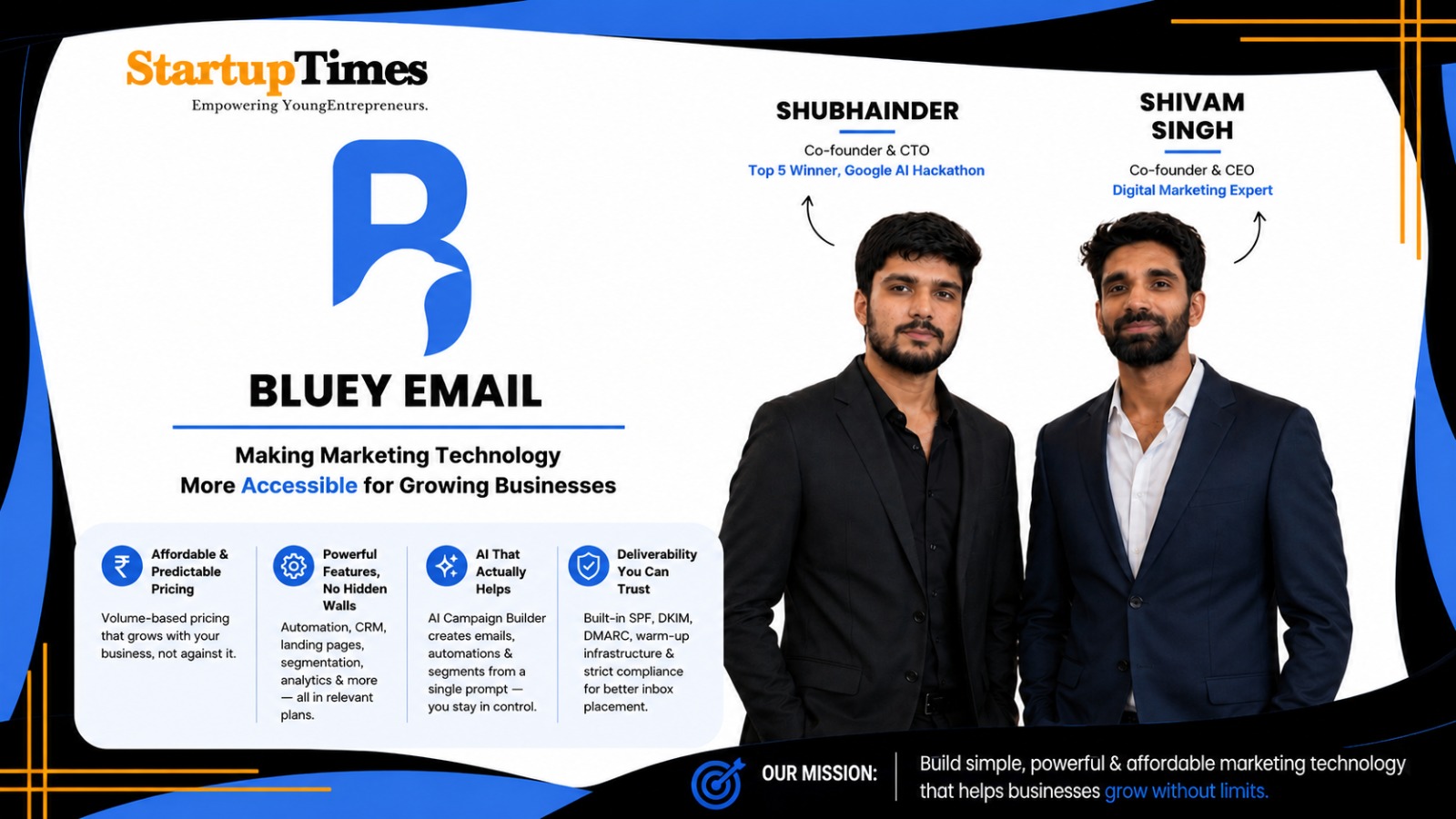
That repeated frustration eventually pushed Shivam and his co-founder Shubhainder to build Bluey Email, an AI-powered email marketing platform focused on making marketing technology simpler, more practical, and accessible for growing businesses.
Rather than building another software platform overloaded with unnecessary complexity, the founders wanted to create something businesses could genuinely use without feeling overwhelmed by technical systems or unpredictable costs.
Building From Real Industry Experience
Before launching Bluey Email, Shivam spent more than eight years working in digital marketing with companies across India, the United States, the United Kingdom, Europe, and Australia. During that time, he worked closely with startups, established brands, and scaling businesses, which gave him firsthand insight into how marketing operations evolve as companies grow.
One challenge appeared repeatedly. Smaller businesses often struggled to find tools that balanced affordability with functionality. Many platforms initially appeared cost-effective, but prices increased significantly as subscriber lists expanded or advanced features became necessary.
Shivam believed there was a major gap in the market for a platform that focused on practical usability rather than excessive feature stacking.
Alongside him is Shubhainder, a software developer and Top 5 winner at the Google AI Hackathon. He has also worked on products like WiseBite, a Chrome extension that helps users identify healthier food products while shopping online, and MeHugo, an AI companion platform.
With Shivam handling the marketing vision and Shubhainder leading the technical side, the duo believed they could build a platform rooted in solving real operational problems for businesses.
A Different Approach to Pricing
According to Shivam, one of the biggest frustrations in the email marketing industry today is pricing unpredictability. Many platforms charge businesses according to contact limits, which means monthly expenses increase rapidly as customer databases grow.
For startups trying to scale steadily, this creates uncertainty. Businesses often find themselves paying far more than expected simply because their campaigns become successful and their subscriber base expands.
Bluey Email was designed with a different pricing philosophy. Instead of focusing heavily on contact-based billing, the company adopted a volume-based approach that allows businesses to scale campaigns without constantly worrying about sudden jumps in pricing.
The founders also chose not to hide essential features behind expensive enterprise subscriptions. Features such as automation workflows, CRM management, landing pages, segmentation, analytics, and AI-powered campaign generation are available within relevant plans so businesses can access tools they actually need while growing.
For the team, accessibility is not only about lower pricing. It is also about making advanced marketing capabilities available to businesses that may not have enterprise-level budgets.
Making AI Useful Instead of Overcomplicated
Artificial intelligence has become one of the most talked-about topics in marketing technology, but Shubhainder believes many companies still treat AI as more of a marketing trend than a practical solution.
According to him, many platforms showcase flashy AI features that look impressive during demonstrations but do little to solve the repetitive tasks marketers deal with every day.
Bluey took a more practical approach to AI integration. The company developed an AI Campaign Builder that helps users create complete campaigns from a single prompt. This includes generating email drafts, automation structures, segmentation logic, and optimization suggestions while still allowing marketers to maintain full control over editing and approvals.
“The goal was never to replace marketers,” Shubhainder says. “We wanted to reduce repetitive work so businesses could focus more on strategy and growth.”
The founders believe AI should support human decision-making rather than complicate workflows further. Their focus has been on saving businesses time without removing the creative control marketers still need.
The Early Challenges of Building a SaaS Platform
Like most SaaS startups, Bluey Email faced several operational challenges during its early growth stage. One of the biggest hurdles was email deliverability.
Building trust with providers like Gmail and Outlook is difficult for new email platforms because even a small number of spam complaints can negatively affect sender reputation.
The founders say a few early users attempted to send campaigns using low-quality contact lists, which the company doesn’t tolerate and became much stricter with onboarding standards and compliance policies.
To strengthen deliverability systems, Bluey introduced automated SPF, DKIM, and DMARC verification along with warm-up infrastructure, bounce handling systems, and auto-suppression tools directly within the platform.
The company also made the difficult decision to reject certain high-volume users who failed to follow proper list hygiene practices, even though doing so impacted short-term revenue.
For Shivam and Shubhainder, maintaining long-term trust and platform quality was far more important than chasing aggressive early growth numbers.
Solving One of the Biggest SaaS Problems
Another major turning point came when the founders realized many businesses were not avoiding Bluey because of the product itself. Instead, they were afraid of the migration process.
Many companies worry about losing customer data, damaging existing workflows, or affecting email deliverability while switching from one platform to another. For small businesses especially, migration often feels technically risky and time-consuming.
To address this concern, Bluey introduced free white-glove migration support across all plans, including entry-level subscriptions. The team personally assists businesses with contact imports, template transfers, suppression lists, automation rebuilding, and overall transition support.
According to Shivam, this single decision significantly improved customer confidence. Businesses became much more comfortable trying the platform once migration no longer felt stressful or uncertain.
The founders believe customer support continues to remain one of the most underestimated aspects of the SaaS industry, particularly for startups and small businesses that may not have dedicated technical teams.
Expanding Beyond Email Marketing
Although email marketing remains Bluey’s core product, the founders see the company gradually evolving into a broader marketing ecosystem.
The platform is already expanding into areas such as SMS marketing, push notifications, social media automation, WhatsApp communication, CRM integrations, and AI-driven campaign management.
The company is also working on Bluey Outreach, a cold-email platform featuring sender rotation and warm-up capabilities, alongside social scheduling and engagement tools that help businesses communicate across multiple channels from a single platform.
Another upcoming product, Bluey Coffee, is being developed as a tool for collecting tips, donations, and selling digital products online.
Despite the company’s larger expansion plans, Shivam says the original philosophy behind Bluey remains unchanged. The focus is still on building marketing tools that are transparent, practical, and genuinely useful for businesses instead of creating unnecessary complexity.
For aspiring entrepreneurs, he believes the strongest businesses are often built around problems founders have personally experienced themselves.
“Trends change constantly,” he says, “but when you’re solving a real problem people genuinely struggle with, the motivation to keep building stays strong.”
Connect With Bluey Email
Website: https://blueyemail.com
Marketing Blogs: https://blogs.blueyemail.com
Email: support@blueyemail.com
LinkedIn: https://www.linkedin.com/company/blueyemail/
Instagram: https://www.instagram.com/blueyemail/