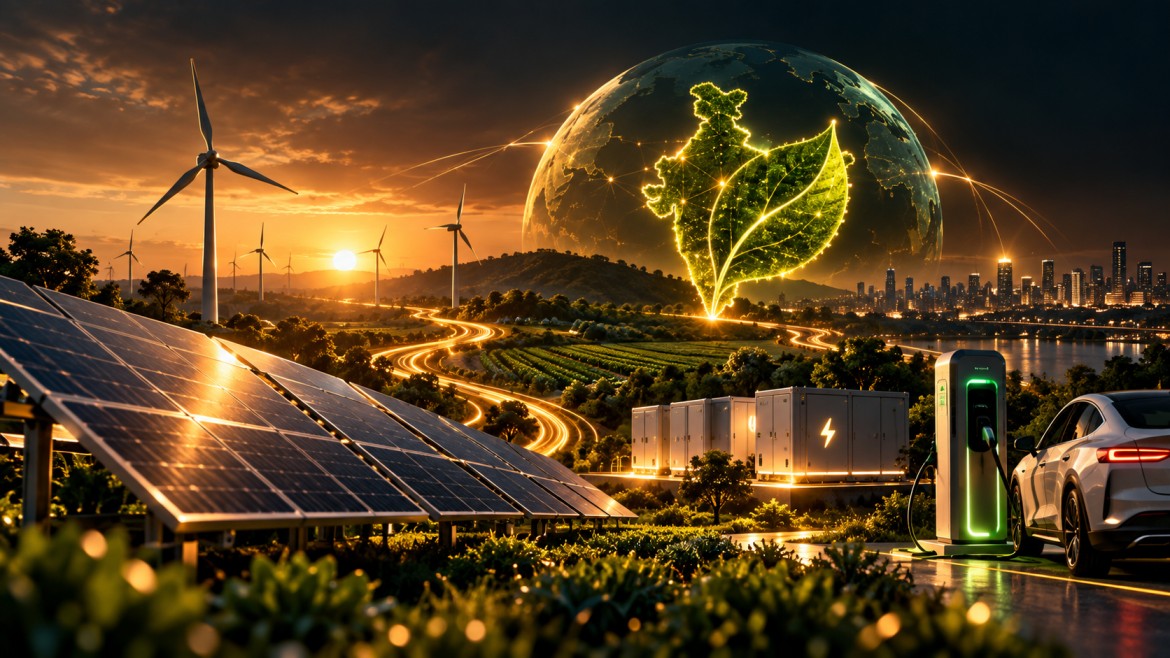
India’s climate-tech opportunity is moving from the margins of the startup ecosystem toward the centre of its industrial and infrastructure story. The opportunity is broader than building solar panels or electric vehicles: it spans energy storage, charging infrastructure, carbon markets, sustainable agriculture, waste, water and technologies that help businesses use resources more efficiently. Funding reflects that shift. According to Tracxn’s India Climate Tech 2026 Report, climate-tech companies in India had raised about $12.8 billion cumulatively across 1,583 funded companies by June 2026, while annual funding rose from about $315 million in 2020 to $2.6 billion in 2025. :contentReference[oaicite:0]{index=0} For founders, the more important signal is not the headline funding number but the expanding number of physical problems that technology can now address at commercial scale.
India’s Energy Transition Is Creating New Business Layers
India’s renewable-energy build-out has created an enormous base on which startups can build specialised products and services. As of August 31, 2026, the country had 168.04 GW of installed solar capacity, including 32.59 GW of grid-connected rooftop solar, according to the Ministry of New and Renewable Energy. :contentReference[oaicite:1]{index=1}
That scale changes the startup opportunity. The market is no longer limited to companies that own generation assets. There is room for software that monitors distributed solar installations, financing platforms that make clean-energy assets easier to fund, predictive maintenance systems, energy-management tools and businesses that integrate solar with storage and commercial consumption.
Rooftop solar illustrates the point particularly well. As installations become more distributed, the industry needs better customer acquisition, installation management, quality assurance, financing and after-sales service. The Ministry of New and Renewable Energy’s rooftop programme already provides a policy framework for residential installations, while PM-KUSUM extends the clean-energy opportunity into agriculture through decentralised renewable plants and solar-powered irrigation. :contentReference[oaicite:2]{index=2}
For entrepreneurs, this creates a useful distinction: the next opportunity may not be inventing another solar module. It may be building the technology, financing or operational infrastructure that makes millions of existing and future clean-energy assets easier to deploy and manage.
Storage Could Become the Missing Layer in Clean Power
Solar generation solves one part of the energy equation but introduces another challenge: electricity production does not always match demand. Battery energy storage systems can help shift electricity across time, support grid stability and make renewable generation more usable.
The scale of the requirement is already visible in official planning. The Central Electricity Authority has estimated a need for 41.6 GW/208 GWh of battery energy storage by FY2029-30. The Ministry of Power has also backed multiple viability-gap-funding mechanisms, including support for a 30 GWh battery-storage programme. :contentReference[oaicite:3]{index=3}
This opens several startup models. Hardware companies can work on battery systems and power electronics. Software startups can optimise charging and discharging decisions. Energy-as-a-service businesses can offer storage without requiring customers to purchase the entire system upfront. Companies can also build specialised solutions for factories, data centres, commercial buildings and renewable-energy developers.
The challenge is capital intensity. Climate-tech founders cannot always follow the software playbook of building cheaply and scaling rapidly. Equipment, manufacturing, project finance, testing and deployment can require substantial upfront capital. That makes partnerships with utilities, industrial companies, banks and infrastructure investors particularly important.
EV Charging Is Becoming an Infrastructure Business
India’s electric-mobility transition is creating another category where the underlying opportunity extends beyond the vehicle. Charging infrastructure, fleet energy management, battery analytics and financing are becoming important parts of the EV ecosystem.
The policy architecture is also evolving. Under PM E-DRIVE, the government has allocated ₹2,000 crore for nationwide public EV charging infrastructure, including tribal and backward areas. The scheme allows implementation through charge-point operators, while the Ministry of Power’s guidelines provide a framework under which private players can establish charging stations. :contentReference[oaicite:4]{index=4}
That does not mean every charging station will become a viable startup. Utilisation, electricity costs, land access, maintenance and location economics can determine whether a charger becomes an asset or an underused piece of infrastructure.
The more interesting opportunities may therefore sit around the network: software that helps fleets optimise charging, systems that forecast demand, payment and roaming platforms, battery-health analytics and charging solutions designed for two-wheelers, three-wheelers, buses and commercial fleets.
Carbon Markets Turn Measurement Into a Business Opportunity
Climate-tech is also moving into an area that looks less physical but could become increasingly important for businesses: carbon measurement and markets.
India has established the Carbon Credit Trading Scheme, with the Bureau of Energy Efficiency maintaining the regulatory framework and subsequent amendments. BEE’s current programme infrastructure also includes the Indian Carbon Market and procedures for compliance and offset mechanisms. :contentReference[oaicite:5]{index=5}
For startups, carbon markets create demand for measurement, reporting, verification and data infrastructure. Businesses will need reliable systems to calculate emissions, track energy use, document reductions and maintain auditable records.
This is particularly relevant for export-oriented industries facing increasingly demanding sustainability requirements in international markets. A startup that can make emissions data more accurate, automated and verifiable can potentially become part of the compliance infrastructure rather than simply selling a sustainability dashboard.
But credibility will be essential. Carbon markets depend on measurement quality and verification. Startups operating in this space will need to build around transparent methodologies and defensible data rather than treating carbon credits as a purely financial product.
Sustainable Agriculture Brings Climate-Tech to India’s Real Economy
Some of the largest climate-tech opportunities may exist far away from technology hubs. Agriculture sits directly at the intersection of weather risk, water use, energy consumption, soil health and farmer income.
Technology companies are already exploring farm analytics, precision irrigation, climate-resilient inputs, biological solutions, supply-chain traceability and systems that help farmers make decisions using local environmental data. IIMA Ventures’ climate-tech landscape identified food and agriculture as one of five major areas of Indian climate innovation, alongside energy, mobility, industrial decarbonisation and waste management. Its research identified more than 800 operational climate-tech startups and highlighted a gap in growth-stage capital, with fewer than 3% of startups in its dataset having raised Series B or later. :contentReference[oaicite:6]{index=6}
The commercial challenge is different from selling enterprise software. Agricultural startups must account for fragmented customers, seasonal purchasing, regional differences and affordability. Successful models may therefore involve partnerships with farmer-producer organisations, agri-input companies, banks, insurers and government programmes rather than relying entirely on direct-to-consumer distribution.
Key Takeaways
- India’s climate-tech ecosystem is expanding from renewable generation into the infrastructure surrounding the energy transition.
- Solar growth is creating opportunities in financing, monitoring, software, maintenance and distributed-energy management.
- Battery storage can become a major technology and infrastructure market as renewable penetration increases.
- EV charging creates opportunities beyond hardware, including fleet software, energy management and battery analytics.
- Carbon markets can generate demand for measurement, verification and emissions-data infrastructure.
- Sustainable agriculture offers climate-tech opportunities in irrigation, farm intelligence, inputs, traceability and resilience.
- Capital intensity and long deployment cycles mean climate-tech startups often need financing models different from conventional software businesses.
The Startup Opportunity Is Bigger Than “Green”
The defining feature of India’s climate-tech opportunity is that it is increasingly becoming an economic infrastructure opportunity. Solar needs software and financing. Batteries need optimisation and project capital. EVs need charging networks. Carbon markets need trusted data. Agriculture needs technology that can improve resource efficiency while working within real farm economics.
That creates a broad field for founders who can combine engineering with commercial execution. It also changes the investor question. The relevant test is not simply whether a startup has a climate benefit, but whether it solves a costly problem for customers while producing measurable environmental value.
India’s next climate-tech companies may therefore look very different from one another. Some will manufacture hardware; others will build software, marketplaces, financing platforms or industrial services. What connects them is the same underlying shift: decarbonisation, energy security and resource efficiency are creating new markets across the economy.
For entrepreneurs willing to work through the complexity of hardware, regulation, infrastructure and long sales cycles, that complexity can itself become a barrier to entry. And in climate-tech, the hardest problems may ultimately create some of the most durable businesses.