
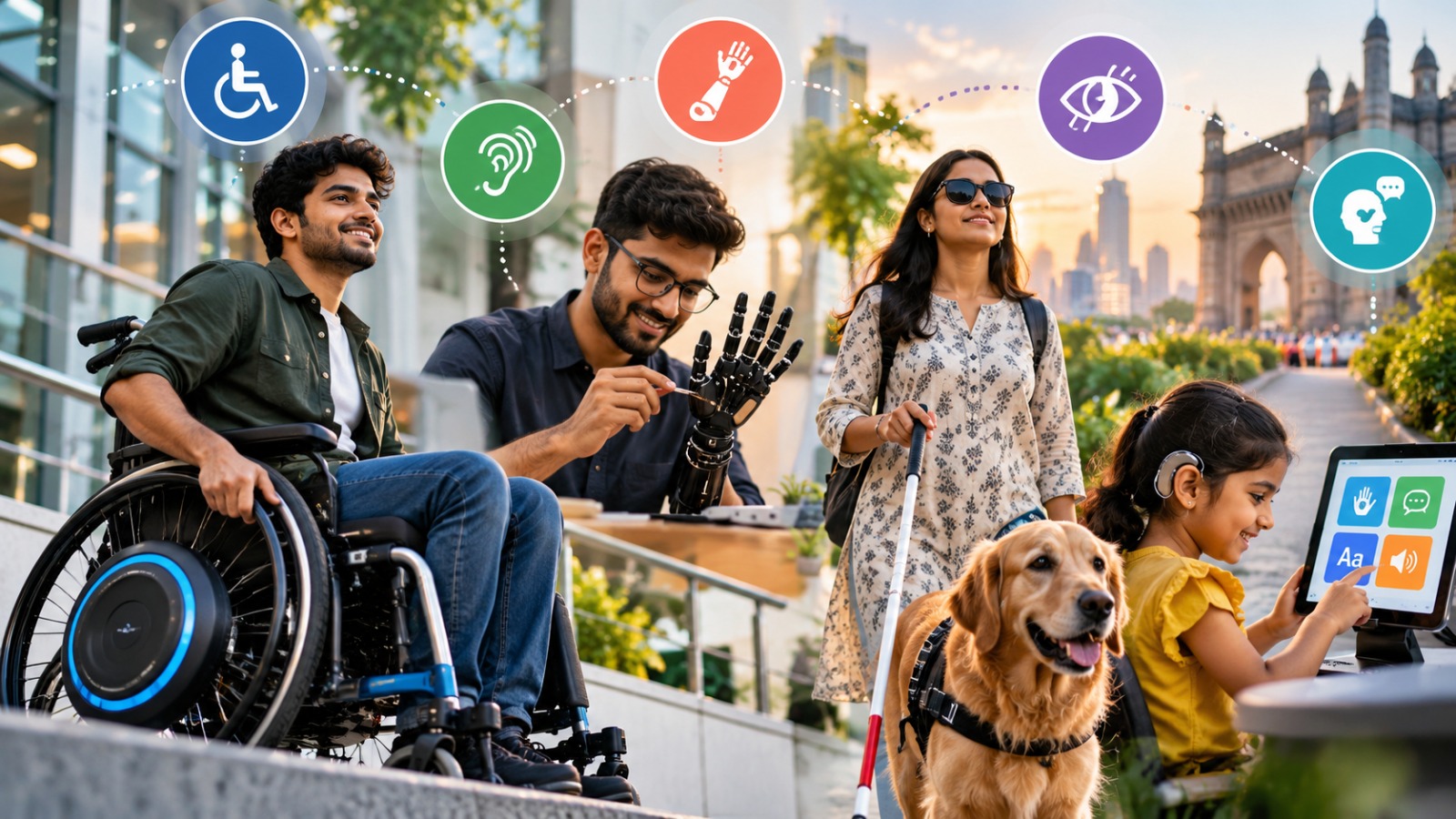
India’s Assistive Technology Market: Startups Building for Accessibility
India’s assistive technology sector is emerging as an important space for startups, with innovations in mobility, communication, healthcare, education and digital accessibility creating new opportunities for inclusive growth.
Assistive technology is becoming an increasingly important part of India’s technology and innovation ecosystem, with startups developing solutions that can improve mobility, communication, education, healthcare and independent living for people with disabilities.
Technology has traditionally been associated with making businesses faster, more connected and more efficient. But its role is expanding beyond productivity. Advances in artificial intelligence, robotics, sensors, software and digital platforms are creating new possibilities for people who face barriers in everyday activities.
From customised wheelchairs and smart mobility devices to AI-powered reading tools and communication systems, Indian startups are increasingly exploring how technology can make products and services more accessible. This emerging ecosystem is also creating opportunities for entrepreneurs, researchers, investors and organisations working towards inclusive innovation.
Understanding Assistive Technology
Assistive technology refers to products, devices, software and systems designed to support people with disabilities in carrying out activities that might otherwise be difficult or inaccessible.
These solutions can range from relatively simple products such as walking aids, hearing devices and Braille tools to advanced technologies involving artificial intelligence, robotics, computer vision and connected devices.
Mobility is one of the most visible areas of assistive technology. However, the sector extends much further. Technologies can support people with visual, hearing, speech, cognitive and learning disabilities, as well as people who require assistance with daily activities.
Digital accessibility is also becoming an important part of the conversation. Screen readers, speech-to-text systems, accessible websites, captioning tools and AI-powered document readers can help people interact with digital information and services.
The objective is not simply to create a technological product. The larger goal is to reduce barriers and enable greater independence, participation and access.
Why India Needs More Accessible Innovation
India has a large and diverse population with different accessibility requirements. However, access to suitable assistive products can vary significantly depending on factors such as location, affordability, awareness and availability of specialised services.
A product that works well for one person may not necessarily work for another. Mobility requirements, physical environments, education needs and communication preferences can differ considerably between individuals.
This creates an important opportunity for startups. Instead of developing products around a single standard user, entrepreneurs can work directly with users and communities to understand specific challenges and develop solutions around those needs.
The shift towards user-centred design is particularly important in assistive technology because the effectiveness of a product often depends on how well it fits into a person's actual environment and daily routine.
From Mobility Solutions to Digital Accessibility
Mobility has become one of the active areas of assistive technology innovation in India.
Startups such as NeoMotion have developed customised wheelchair and mobility solutions designed around individual users. Its products include the NeoFly customised wheelchair and NeoBolt electric mobility attachment. The company's approach illustrates how engineering and personalisation can be combined to address mobility challenges.
Other Indian organisations and startups are working on solutions for visual impairment, communication and education. The Department of Empowerment of Persons with Disabilities maintains information on assistive technology providers, including organisations working on smart canes, AI-based reading solutions, Braille devices and other accessibility products.
This range of solutions shows that assistive technology is no longer limited to traditional medical or rehabilitation equipment. It is increasingly becoming part of the broader technology ecosystem.
The Role of Artificial Intelligence
Artificial intelligence is creating another layer of opportunity for assistive technology startups.
AI-powered systems can process images, recognise text, understand speech and generate responses in ways that can support people with different accessibility requirements.
For someone with a visual impairment, for example, computer vision can potentially help identify objects, read printed information or provide descriptions of surroundings. Speech recognition and natural-language technologies can support communication, while AI-based learning systems can adapt educational content to different needs.
Indian startups are already experimenting with these applications. Thinkerbell Labs, for example, has developed Annie, a self-learning Braille device designed to support literacy for people with visual impairment. Other startups are exploring AI-powered reading, mobility and communication solutions.
However, AI in assistive technology also needs to be approached carefully. Accuracy, affordability, privacy and reliability can be especially important when a person depends on a technology for communication, navigation or access to information.
Building a Startup Ecosystem Around Accessibility
The growth of assistive technology requires more than individual entrepreneurs. It depends on an ecosystem involving research institutions, government organisations, investors, corporations, healthcare professionals and the people who ultimately use these products.
India has already seen initiatives aimed at supporting startups in this sector. BIRAC, Social Alpha and Mphasis have previously collaborated on programmes supporting assistive technology startups, including ventures working across speech and hearing impairment, locomotor disability, visual impairment and intellectual disability.
More recently, the NCPEDP-Mphasis Assistive Technology Hub has continued to support startups through seed grants, mentorship, user access and ecosystem support. New cohorts have included startups working on areas such as healthcare, mobility, orthopaedic solutions and other assistive technologies.
Such programmes can be important because assistive technology startups often need to solve two problems simultaneously: developing technically reliable products and making those products affordable and accessible to the people who need them.
Government Support and the Accessibility Push
Government programmes are also influencing the development and adoption of assistive technologies in India.
The Assistance to Disabled Persons for Purchase/Fitting of Aids and Appliances, commonly known as the ADIP Scheme, is designed to support eligible persons with disabilities in obtaining modern aids and appliances that can assist rehabilitation and improve economic and social participation.
The Union Budget 2026–27 also proposed the Divyang Sahara Yojana, under which the Artificial Limbs Manufacturing Corporation of India is expected to receive support to expand production of assistive devices, strengthen research and development, and incorporate advanced technologies including artificial intelligence.
Digital accessibility is receiving attention as well. The Department of Empowerment of Persons with Disabilities has been working on accessibility standards and maintains lists of empanelled accessibility auditors for digital and built environments.
These developments indicate that accessibility is increasingly being considered not only as a social responsibility but also as an area where technology, standards and innovation need to work together.
Opportunities for Indian Startups
The assistive technology sector presents opportunities across multiple industries.
Healthcare startups can develop rehabilitation and monitoring technologies. Hardware companies can build mobility and communication devices. AI startups can develop tools for vision, speech, education and accessibility. EdTech companies can create learning platforms designed around different learning requirements.
There is also an opportunity in accessible digital infrastructure.
As more government services, financial services, education platforms and businesses move online, accessibility becomes increasingly important. Startups specialising in accessible website design, software testing, voice interfaces, captioning and digital accessibility auditing can potentially serve businesses that need to make their digital products easier to use.
The opportunity therefore extends beyond selling physical devices. Accessibility can become part of software, infrastructure and service design.
The Challenge of Affordability
One of the biggest challenges for assistive technology startups is balancing innovation with affordability.
Advanced hardware can require significant research, manufacturing and testing. Imported components can increase costs, while specialised products may have a relatively small initial customer base.
For startups, achieving scale can therefore be difficult. A highly customised product may provide significant value to an individual user but can also be more expensive to manufacture.
This makes local manufacturing, modular product design, partnerships and alternative financing models important considerations for the sector.
Government programmes, CSR initiatives, institutional partnerships and ecosystem grants can also help bridge the gap between product development and widespread adoption.
Designing With Users, Not Just for Users
Assistive technology works best when the people who will use the product are involved in the development process.
Startups need to understand real-world conditions rather than relying only on assumptions. A wheelchair designed for an indoor environment may face different requirements when used on uneven roads. A digital reading tool may need to work across different languages and document formats. A learning device may need to function in schools with limited infrastructure.
User feedback can therefore influence everything from product design and pricing to usability and after-sales support.
This approach can also help startups avoid creating technology that is technically impressive but difficult to use in everyday situations.
The Growing Role of Inclusive Design
Assistive technology is also contributing to a broader idea: products designed for accessibility can often benefit a much wider population.
Voice interfaces, automatic captions, text-to-speech systems and simplified digital interfaces were developed partly to address accessibility requirements, but they can also be useful for older adults, people learning new languages, people working in noisy environments and users who simply prefer alternative ways of interacting with technology.
This creates an opportunity for startups to think beyond a narrow definition of the accessibility market.
Instead of treating accessibility as an additional feature added after a product is developed, companies can incorporate inclusive design into the product from the beginning.
Startup India’s National Startup Awards 5.0, for example, included an Inclusive Design Excellence category recognising startups developing products and services with accessibility and inclusivity at their core.
What Lies Ahead?
The next phase of India's assistive technology ecosystem could be shaped by the convergence of artificial intelligence, robotics, connected devices and digital platforms.
AI could make assistive tools more personalised. Sensors could allow devices to respond to changing environments. Robotics could support mobility and rehabilitation, while accessible digital platforms could make education, employment and public services easier to access.
At the same time, the success of these technologies will depend on factors beyond innovation. Affordability, reliability, user involvement, distribution, awareness and accessibility standards will remain important.
India's startup ecosystem has an opportunity to approach accessibility as both a social requirement and an area of technological innovation. The companies that understand the everyday problems faced by users and build practical solutions around those problems could contribute to a more inclusive technology landscape.
The shift is ultimately about more than creating new devices. Assistive technology is changing the way entrepreneurs think about who technology is designed for and how innovation can remove barriers. From customised mobility solutions and Braille learning devices to AI-powered accessibility tools, Indian startups are demonstrating that technology can play a role in creating greater independence and participation.
As India's technology ecosystem continues to expand, accessibility could become an increasingly important part of the country's next generation of innovation.
For more insights into India’s startup ecosystem, emerging technologies and the industries shaping the future, visit Startup Times.


Leave a comment
Your email address will not be published. Required fields are marked *
Add a newsletter to your widget area.
Top Stories