
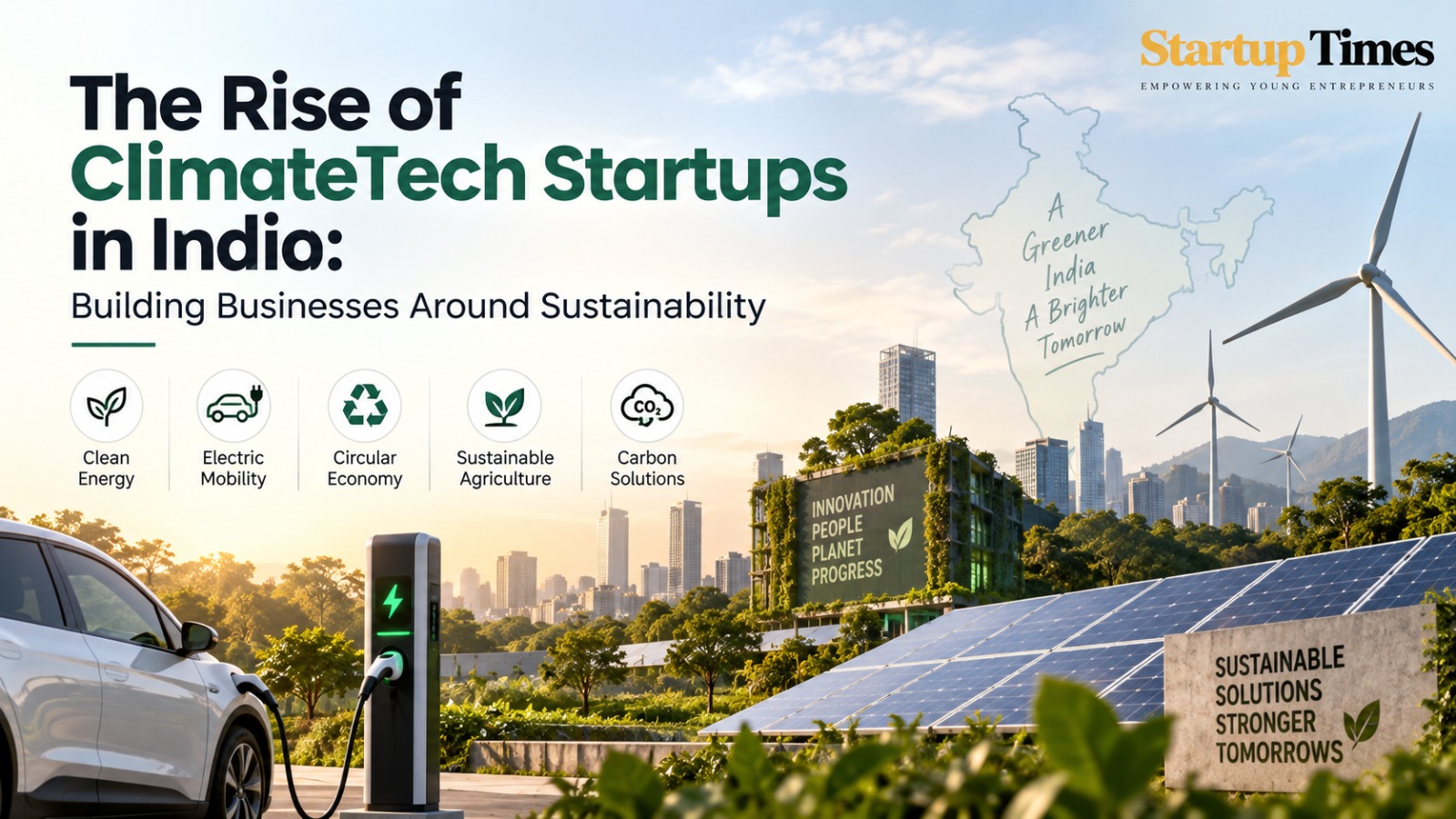
The Rise of ClimateTech Startups in India: Building Businesses Around Sustainability
India’s climate tech ecosystem is expanding across clean energy, electric mobility, waste management, sustainable agriculture, energy storage and carbon solutions, creating new opportunities for startups to build businesses around sustainability.
India’s startup ecosystem is entering a phase where solving environmental challenges is increasingly becoming a business opportunity. From renewable energy and electric mobility to sustainable agriculture, waste management, energy storage and carbon solutions, a growing number of startups are building companies around the need for a more sustainable economy. ClimateTech is no longer limited to a small group of companies working on environmental projects; it is becoming a broader category of businesses combining technology, innovation and commercial models to address some of India’s most pressing climate and resource challenges.
India’s ClimateTech ecosystem has expanded significantly over the past decade. More than 800 ClimateTech startups are currently operating across the country, working in areas such as energy generation and consumption, food and agriculture, transport and mobility, industrial decarbonisation, and waste management and circularity. This diversity reflects the scale of the opportunity: climate-related challenges exist across almost every major part of the Indian economy.
One of the biggest areas of ClimateTech activity is energy. India’s growing demand for electricity, combined with the expansion of renewable energy, is creating opportunities for startups working beyond traditional solar and wind generation. Companies are developing solutions around energy storage, battery technologies, grid management, energy efficiency and alternative fuels. Energy storage is particularly important because renewable sources such as solar and wind are variable. As India integrates larger amounts of renewable power into its electricity system, technologies that can store and manage energy can become increasingly important to the reliability of the transition. The country is also developing an ecosystem around green hydrogen, creating opportunities for startups working on production technologies, electrolysers, storage and related infrastructure.
Electric mobility has been another visible part of India’s ClimateTech story. Startups have entered the market across electric two-wheelers, three-wheelers, passenger vehicles, commercial mobility, charging infrastructure, battery technology and fleet solutions. However, the broader ClimateTech opportunity extends beyond simply replacing petrol and diesel vehicles with electric ones. Businesses are also working on battery recycling, energy management, financing, fleet optimisation and the infrastructure required to make electric mobility practical at scale. The evolution of this sector demonstrates how a climate challenge can create opportunities across an entire value chain rather than producing only one category of product.
Agriculture represents another important frontier. India’s agricultural sector faces challenges related to water availability, changing weather patterns, soil health, productivity and supply-chain efficiency. Climate-focused startups are developing technologies and business models that can help farmers use resources more efficiently while improving productivity and resilience. These can include precision agriculture, climate-smart farming practices, alternative inputs, water-management solutions and technologies that reduce losses between farms and consumers. For startups, the challenge is not simply creating technology but making that technology affordable, accessible and useful for a diverse agricultural market.
Waste management and the circular economy are also creating a new generation of businesses. India produces enormous quantities of municipal, industrial, agricultural and electronic waste, creating both an environmental challenge and a potential source of economic value. Startups are exploring ways to collect, sort, recycle, reuse and transform waste into useful materials and products. The circular economy approach changes the traditional idea of waste from something that needs to be disposed of into a resource that can potentially re-enter the production cycle. This creates opportunities for businesses while also addressing resource efficiency and waste-management problems.
Industrial decarbonisation presents an even more complex opportunity. Industries such as steel, cement, chemicals and manufacturing require large amounts of energy and often depend on processes that are difficult to replace quickly. Startups are therefore exploring technologies that can reduce energy consumption, improve industrial efficiency, replace carbon-intensive materials or introduce alternative production methods. Green hydrogen, low-carbon materials, industrial energy-management systems and carbon-management technologies are among the areas attracting increasing attention. The challenge for these businesses is significant because industrial technologies often require substantial capital, long development cycles and cooperation with established industries.
Another emerging area is the use of data and artificial intelligence to understand environmental conditions and improve decision-making. ClimateTech startups can use sensors, satellite data, artificial intelligence and analytics to monitor air quality, weather patterns, flooding, energy consumption and other environmental indicators. Climate intelligence platforms can help businesses and governments understand environmental risks and make decisions based on real-time or historical data. This creates an interesting intersection between digital technology and sustainability, where software and data can complement physical climate solutions.
The growing ClimateTech ecosystem is also changing how investors look at sustainability. Climate businesses traditionally faced a difficult challenge: many solutions required significant upfront investment, long development timelines and infrastructure before they could generate substantial revenue. Increasing investor attention to climate-focused businesses is creating more opportunities for startups to develop and commercialise these technologies. However, accessing growth-stage capital remains a challenge for many companies, particularly those developing hardware-intensive technologies.
That funding gap is important because building a ClimateTech company is often different from building a purely digital startup. A software company may be able to reach thousands of customers without building physical infrastructure, while a company developing batteries, industrial equipment, energy systems or recycling facilities may need factories, specialised equipment, testing facilities and regulatory approvals. A startup may successfully prove that its technology works in a laboratory or pilot project but still struggle to raise the capital required to manufacture it at scale.
This is sometimes described as the “valley of death” for climate innovation. A startup may successfully demonstrate that its technology works but struggle to move from a pilot project to large-scale commercialisation. The problem becomes particularly difficult when the product is hardware-heavy or requires large infrastructure investments. High adoption costs, manufacturing requirements, research and development expenses and limited customer awareness can all create additional barriers.
For founders, this means that a strong ClimateTech business needs more than a good environmental idea. It needs a clear customer, a sustainable revenue model and a realistic path to scale. A startup developing a technology that reduces energy consumption, for example, needs to demonstrate not only that it reduces emissions but also that customers can understand the financial benefit of adopting it. In many cases, the strongest commercial proposition may come from combining environmental impact with cost savings, improved efficiency, regulatory compliance or increased productivity.
This is also where India’s scale becomes significant. The country has a large population, rapidly growing cities, expanding industrial activity and increasing demand for energy and mobility. These characteristics create substantial environmental pressures, but they also provide a large potential market for solutions that can reduce resource consumption and improve efficiency. A technology that works economically in India could potentially find applications in other emerging markets facing similar challenges.
Government policy is another important part of this ecosystem. Climate-focused businesses often depend on regulations, incentives, infrastructure and public procurement because many climate technologies compete against established systems with decades of investment behind them. India has introduced initiatives covering areas such as renewable energy, green hydrogen, battery manufacturing and electric mobility. The development of transmission infrastructure, storage systems and industrial clusters can also influence whether new technologies are able to move from pilot projects to commercial deployment.
At the same time, policy support alone cannot create successful ClimateTech companies. Startups need customers, private investment, skilled talent, research capabilities and manufacturing partners. Collaboration between startups, large corporations, universities, investors and government institutions can therefore become an important part of the ecosystem. Industrial clusters, for example, can help companies access infrastructure and potential customers while reducing some of the challenges associated with building new technologies independently.
The next phase of India’s ClimateTech ecosystem is likely to involve a shift from simply proving that technologies can work to demonstrating that they can work economically and at scale. This could mean greater attention to energy storage, industrial decarbonisation, sustainable materials, water efficiency, climate intelligence, circular economy models and carbon-management technologies alongside the already established renewable energy and electric mobility markets.
For entrepreneurs, this creates an opportunity to approach sustainability not simply as a social objective but as a business-design challenge. The question is no longer only how technology can reduce environmental impact. It is also about identifying where environmental problems create inefficiencies, additional costs, resource constraints or unmet customer needs and then developing commercially viable solutions around them.
India’s ClimateTech story is therefore still being written. The country has a growing base of startups, increasing investor interest, expanding policy support and a large domestic market facing complex environmental challenges. Yet significant hurdles remain, particularly around scale-up funding, hardware manufacturing, adoption costs and commercialisation. The startups that can bridge the gap between climate impact and strong business fundamentals will play an important role in shaping how India approaches its next stage of economic growth.
As sustainability becomes increasingly connected with energy security, resource efficiency, industrial competitiveness and long-term economic development, ClimateTech is moving closer to the centre of India’s startup conversation. What began as a niche category is becoming a broader entrepreneurial opportunity—one where building a successful business and addressing environmental challenges can increasingly become part of the same equation.
To explore more startup stories, industry insights, and emerging business trends, visit StartupTimes.

Leave a comment
Your email address will not be published. Required fields are marked *
Add a newsletter to your widget area.
Top Stories