There's a particular kind of silence that falls over a room when someone realizes the person they've been arguing business strategy with for twenty minutes was born after the iPhone.
It happened to venture capitalists in 2021. It happened to enterprise clients meeting a "senior consultant" over Zoom in 2018. And if the current crop of Indian founders is anything to go by, it's going to keep happening.
This isn't a listicle. It's the story of three young men who decided that "wait until you're older" was optional advice — and who are now proof that conviction, timing, and an unreasonable work ethic can outrun a resume every single time.

Before there was Zepto, there was a broken carpool app.
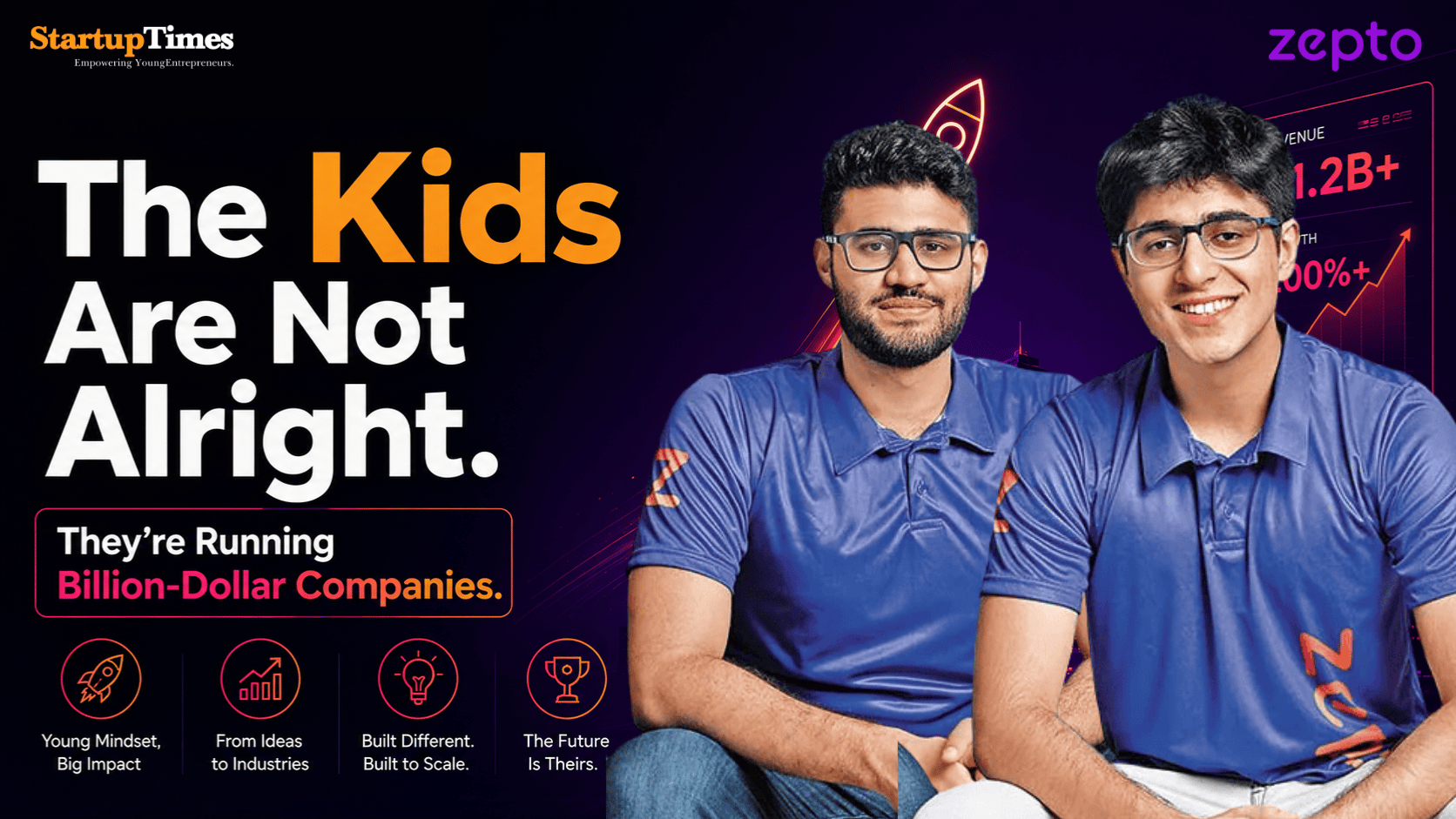
Aadit Palicha and Kaivalya Vohra didn't meet at a startup incubator or a hackathon. They met as schoolkids in Dubai, at GEMS Modern Academy, doing the kind of things bored, sharp teenagers do — except their version of boredom was building software. At 17, Palicha launched GoPool, a carpooling app meant to ease school-run traffic for parents in Dubai. It got a grant from Emirates NBD. It also, by most accounts, flopped.
Most people would call that a closed chapter. Palicha and Vohra called it a warm-up.
Both went on to enroll at Stanford to study computer science — the kind of credential most families spend a lifetime chasing. Then March 2020 happened. Campuses shut. The two friends, back home and stuck indoors, ran into a problem that suddenly felt universal: getting groceries was a nightmare. Delivery slots were booked out for days. Supermarkets had queues stretching around the block. As two twenty-somethings living alone, this wasn't an abstract inconvenience — it was dinner.
So they built KiranaKart, a grocery delivery app that partnered with local kirana stores to deliver in 45 minutes. It raised over $700,000 in pre-seed funding from names like Global Founders Capital. And then — it didn't work. The unit economics were brutal, the model didn't scale, and by their own admission, product-market fit never quite clicked.
Here's the part that actually matters for anyone paying attention: they didn't quit. They rebuilt.
In 2021, Zepto launched, backed by Y Combinator, promising to deliver groceries in ten minutes instead of forty-five. It sounds like a small tweak. It wasn't. It meant rethinking the entire supply chain — dense networks of hyperlocal "dark stores" instead of a handful of large warehouses, route optimization down to the minute, inventory stocked block by block instead of city by city. The pivot took the company from a nineteen-year-old's second attempt at a startup to a five-billion-dollar business in under three years.
By late 2022, Zepto — founded by two Stanford dropouts still in their early twenties — had raised $200 million at a $1.4 billion valuation, making it one of the fastest Indian companies to reach unicorn status. It wasn't a fluke round. Investors like StepStone Group and Goodwater Capital weren't betting on nostalgia for young founders — they were betting on execution they could see in the numbers.
Forbes India would later describe Palicha and Vohra as founders whose journey was never about impulsive decisions or youthful bravado, but calculated risk and relentless learning. Palicha has been blunt about this himself: the decision to leave Stanford wasn't made on a whim — it came only after they'd already found product-market fit standing inside a dark store in Bandra. College was the fallback plan. Zepto was the plan.
What happened next is the part most twenty-three-year-olds only get to fantasize about. Zepto moved toward a ₹9,500-crore IPO, with Palicha, at 23, on course to become India's youngest CEO of a publicly listed company. Neither he nor Vohra chose to sell down their own stakes in the offering — the share sale was built around existing investors, not founder exits. Translation: they weren't cashing out. They were staying in.
There's a quieter detail buried in most of the coverage that says more about the culture Palicha and Vohra built than any funding headline. A former Zepto leadership team member once said that being one of the "older" people in the room at 25 or 26 was, for once, a relief — because age had simply stopped being the thing anyone questioned. That's not a personality trait. That's an operating system for how a company hires, promotes, and moves.
Zepto's origin story isn't really about being young. It's about being willing to publicly fail (KiranaKart), diagnose exactly why, and rebuild the thesis without ego. The age just made it a better headline.
The lesson underneath the headline
Advait Thakur: The Founder Who Was Coding Before He Had a Bank Account
If Palicha and Vohra's story is about pivoting fast, Advait Thakur's is about starting absurdly early — and never really stopping.
Born in 2003, Thakur was coding and exploring the internet's potential by age nine. Most nine-year-olds are figuring out multiplication tables. Thakur was building websites. He launched his first website at nine years old and had, by his teens, already begun working with Google's AI and Natural Language Processing APIs — tools that plenty of working software engineers only pick up years into their careers.
At just 14, Thakur founded Apex Infosys India, an IT and digital transformation company offering web development, enterprise applications, and machine learning services. It didn't start as a grand plan to disrupt an industry. In his own words, the idea grew out of noticing that NGOs doing genuinely good work had no real way to build an online presence, boxed out by an overpriced digital media industry. So he built the alternative himself, starting as what he's called a solo coder working out of Mumbai.
Being a teenage founder pitching to clients came with an obvious, recurring obstacle: nobody believed him at first. Advait faced real hurdles in the early days — limited resources and skepticism rooted purely in his age. He pushed through it by continually upgrading his own skills, actively networking with industry mentors, and simply delivering work good enough that clients stopped caring how old he was. There's no shortcut hidden in that sentence. It's just repetition, applied for years, starting before most kids have a part-time job.
By 2019, Apex Infosys had pivoted toward home automation and IoT, building unified smart home systems for lighting, climate control, security, and intercom access — all designed with a deliberate focus on local data processing rather than routing everything through the cloud. It's a genuinely unusual bet for an Indian IT services company to make: prioritizing privacy-by-design in smart homes years before "data localization" became a boardroom buzzword.
He didn't stop at one company. Thakur went on to co-found Crophle, an agri-tech platform using AI and IoT to help Indian farmers monitor soil and weather conditions and increase crop yields — tackling a problem about as far from smart-home automation as it gets, but united by the same instinct: find where technology is genuinely underused, and go build the missing piece.
By 19, Thakur was being recognized as one of the youngest CEOs in the country, featured by CEOInsights and profiled by India Today Magazine as a young entrepreneur changing the world. He was also named to Ummid.com's list of "Six Entrepreneurs Under 25 Making Waves," and to The Startup's list of India's hottest young entrepreneurs.
The lesson underneath the headline: Thakur's real edge was never his age — it was that he treated "too young to be taken seriously" as a solvable engineering problem, not a wall. He solved it the same way he solved everything else: build something undeniable, and let the work argue on your behalf.
What These Founders Actually Have in Common
Strip away the headlines about age, and a pattern shows up that's a lot more useful than "wow, they're so young":
- They started with a failure, not a masterstroke. GoPool flopped. KiranaKart flopped. Apex Infosys's earliest version wasn't the smart-home company it became. None of these founders got it right on attempt one — they just didn't stop after attempt one.
- They chased a real, specific, personally-felt problem. Zepto came from two guys who genuinely couldn't get groceries delivered during lockdown. Apex Infosys came from watching NGOs get priced out of visibility they deserved. Neither started with "let's build a startup" — they started with "this is broken and it's annoying me."
- They let credentials become optional. Stanford was a real thing Palicha and Vohra were prepared to walk away from — twice — because the business was already working. Thakur never had the credential to begin with, and built one anyway, just made of client results instead of a degree.
- They treated their age as a temporary tax, not an identity. Every one of these founders talks less about being young and more about the mechanics of the work — dark store density, IoT data privacy, agri-tech sensors. The age fades into the background the moment the product does the talking.
If there's a single throughline for Gen-Z founders breaking out in India right now, it's this: they're not asking for permission to be taken seriously. They're just shipping until the question stops coming up.
About Startup Times
Startup Timhttps://startuptimes.net/es is India's emerging business media platform covering startup stories, founder journeys, funding announcements, industry insights, and the entrepreneurs shaping the future of business. Through in-depth editorials and original reporting, Startup Times documents the people and ideas building tomorrow's economy.