
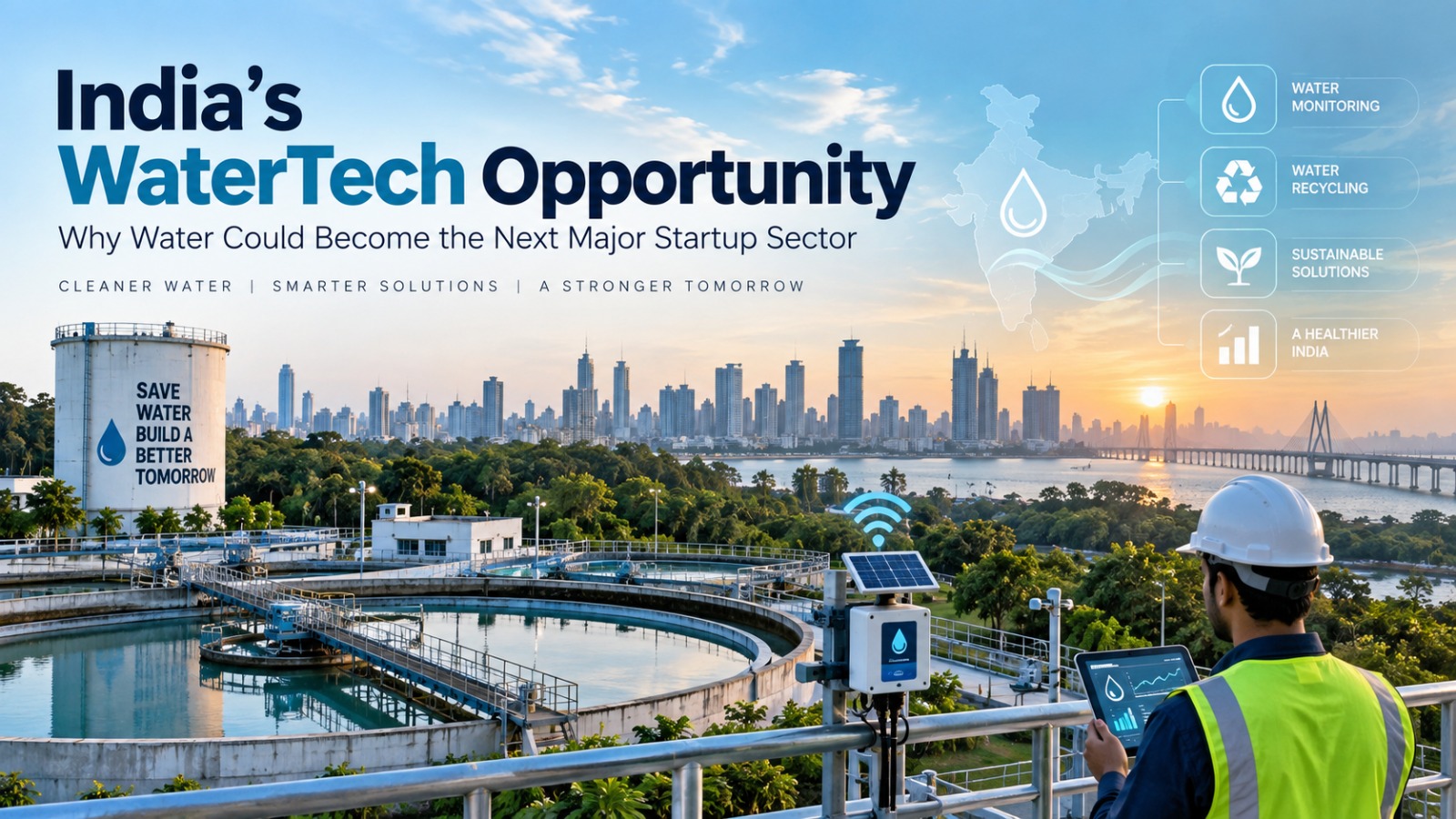
India’s WaterTech Opportunity: Why Water Could Become the Next Major Startup Sector
India’s water challenges are creating new opportunities for startups using technology to improve water management, treatment, conservation and reuse.
Water has traditionally been viewed as a public utility and an environmental concern, but that perception is beginning to change. Across India, water is increasingly becoming a technology, infrastructure and business challenge. Growing cities, expanding industries, changing rainfall patterns, rising agricultural demand and pressure on groundwater are creating problems that cannot be addressed through conventional infrastructure alone. At the same time, these challenges are opening a new space for entrepreneurs building technologies around water management, conservation, treatment, monitoring and reuse. This emerging ecosystem, broadly referred to as WaterTech, could become an important area of innovation for India’s startup economy.
The scale of the opportunity becomes clearer when looking at India’s groundwater situation. According to the Central Ground Water Board’s 2025 assessment, India had an estimated annual groundwater recharge of 448.52 billion cubic metres and annual extractable groundwater resources of 407.75 billion cubic metres. Groundwater extraction was estimated at 247.22 billion cubic metres, representing a national stage of groundwater extraction of 60.63%. The assessment also classified 730 out of 6,762 assessment units as over-exploited, meaning extraction in those areas exceeded the annual replenishable groundwater resource.
These numbers do not mean that India faces one uniform water crisis. Water availability differs significantly across regions, and government assessments have also recorded improvements in several groundwater indicators over recent years. However, the data highlights an important business reality: water management is becoming increasingly dependent on accurate measurement, efficient usage, timely intervention and better infrastructure. This creates a space where technology can complement traditional water-management systems rather than simply replace them.
This is where WaterTech enters the picture. The term covers a broad range of technologies designed to improve how water is sourced, distributed, consumed, treated and reused. A WaterTech company could develop sensors that detect leaks, software that analyses water consumption, systems that improve wastewater treatment, technologies that monitor water quality or solutions that help industries reduce their water footprint. The opportunity therefore extends far beyond drinking-water purification. It touches agriculture, manufacturing, construction, real estate, municipalities, hospitality, healthcare and almost every industry that depends on water.
One of the most interesting developments is the increasing use of sensors, Internet of Things technology, artificial intelligence and data analytics in water management. Traditionally, organisations could know how much water they were consuming only after reviewing periodic readings or manual records. Connected monitoring systems can provide more frequent or real-time information, allowing businesses to identify unusual consumption, leaks or operational inefficiencies much earlier. For industries where water is a significant operational input, turning water usage into measurable data can help transform water management from a reactive activity into a continuous optimisation process.
Indian startups are already demonstrating how this model can work. Digital Paani, for example, uses IoT-enabled technology for wastewater management. According to NITI Aayog’s Frontier Tech platform, the company was treating more than 90 million litres of wastewater daily as of June 2025 and had worked with major industrial customers including Tata and Reliance. Its approach illustrates how digital technology can be integrated with physical water-treatment infrastructure to improve operational efficiency.
Another example is FluxGen, which focuses on water intelligence and monitoring. Its technology uses sensors, analytics and AI-powered insights to help organisations monitor water consumption and identify inefficiencies. The company’s current platform includes real-time monitoring, water-use analytics, anomaly detection and predictive insights, demonstrating how software and connected hardware can become part of the infrastructure through which businesses manage water.
Agriculture represents another significant opportunity. A large share of India’s groundwater extraction is linked to irrigation. The 2025 groundwater assessment estimates that around 215 billion cubic metres, or approximately 87% of total groundwater extraction, was used for irrigation, while domestic and industrial uses accounted for much smaller shares. This creates opportunities for technologies that can help farmers use water more efficiently. Precision irrigation, soil and moisture monitoring, weather-linked irrigation systems, automated pumps and data-driven farming tools could help improve the relationship between crop requirements and water consumption.
The industrial sector presents another major market for WaterTech. Manufacturing facilities often require water for processing, cooling, cleaning and other operational activities. Instead of treating wastewater purely as a disposal problem, companies can increasingly look at treatment and reuse as part of a circular water strategy. Technologies that enable industries to monitor consumption, recover water, improve treatment efficiency and reuse treated wastewater could therefore create both environmental and operational value.
Urban India offers a similar opportunity. As cities expand, water networks become more complex, and municipalities have to manage everything from supply and distribution to sewage and stormwater. Leak detection, smart metering, digital water networks, water-quality monitoring and data-driven infrastructure management could help cities understand their water systems in greater detail. The opportunity is particularly relevant because urban water systems often involve large physical networks where small inefficiencies can translate into significant losses over time.
Government initiatives are also beginning to create a stronger institutional pathway for water innovation. Under AMRUT 2.0, the Ministry of Housing and Urban Affairs has established a technology sub-mission focused on startups and innovative technologies in the water sector. A government release stated that ₹667 crore had been allocated for the technology sub-mission and that 107 startups had been onboarded through the challenge process as of December 2023. These startups were working across areas including fresh-water systems, hydro-informatics, used-water management, urban water management, agricultural water management, sewerage management and water governance.
More recently, the government has placed additional emphasis on research and entrepreneurship in the water sector. In June 2026, the Ministry of Jal Shakti launched an open call for startups and MSMEs under the Bharat Water Innovation Network, or Bharat WIN. The initiative focuses on areas including wastewater treatment, water-use efficiency, climate resilience, smart water grids, IoT and data-driven water management, precision agriculture, rainwater harvesting, water-quality management and urban hydrology. Selected high-impact proposals can receive grant-in-aid for developing innovative solutions.
The development of this ecosystem is important because WaterTech has traditionally faced a challenge that many software-first startups do not: infrastructure. A water-management startup may need sensors, treatment equipment, testing facilities, field installations, maintenance networks and regulatory approvals before its solution can reach scale. Customer decision-making can also take longer because municipalities, industrial companies and infrastructure operators often require pilots and technical validation before adopting a new system. This means that building a WaterTech company can require patience, domain expertise and the ability to combine technology with real-world infrastructure.
At the same time, this complexity can create opportunities for specialised startups. Not every WaterTech company needs to build an entire treatment plant or water network. Some can focus on software, others on sensors, monitoring systems, testing technologies or specialised components. This opens the door for different business models, from hardware sales and technology licensing to software subscriptions, managed services and performance-based models. As the ecosystem develops, startups that can demonstrate measurable savings, improved efficiency or reliable water-quality outcomes may find opportunities to work with businesses as well as public-sector organisations.
Water quality is another area where technology could play an increasingly important role. In July 2025, the government reported that, during 2025–26, millions of water samples had already been tested through laboratories and field-testing kits under the Jal Jeevan Mission’s water-quality monitoring framework. The scale of testing highlights the importance of reliable monitoring systems and the potential role of portable testing devices, digital reporting and real-time water-quality technologies.
The startup opportunity, therefore, is not simply about creating another water purifier. It is about building the digital and technological layer around the entire water cycle. Where is water being consumed? How much is being lost? Can wastewater be treated and reused? Can a leak be identified before it becomes expensive? Can farmers receive better information about irrigation? Can industries measure and reduce their water footprint? Can cities make decisions based on real-time information rather than delayed reports? These questions represent potential markets for entrepreneurs.
There is also a larger shift taking place in how businesses think about sustainability. Companies are increasingly expected to understand and report how they use natural resources, particularly when those resources directly affect operational continuity. For water-intensive businesses, improving water efficiency is not only an environmental objective; it can also become a way to manage costs, reduce operational risks and strengthen long-term resilience. This makes WaterTech relevant not only to sustainability teams but also to operations, finance and infrastructure decision-makers.
However, the sector will not grow simply because the problem is large. WaterTech startups will need to prove that their solutions work outside controlled environments and can operate economically at scale. Technologies must be affordable enough for customers, reliable enough for long-term deployment and adaptable to India's highly diverse geographic and infrastructure conditions. Startups will also have to navigate fragmented water systems, different state-level requirements, procurement processes and the practical realities of maintaining technology in the field.
That makes partnerships particularly important. The future of WaterTech in India is unlikely to be built by startups working in isolation. Universities, research institutions, governments, infrastructure companies, industries and investors can all play a role in taking technologies from prototypes to real-world deployment. The government's recent efforts through Bharat WIN and the MAHA Water Mission reflect this broader movement toward connecting research, innovation, startups and implementation. The ₹200-crore MAHA Water Mission announced in June 2026, for example, is intended to support technology development, field validation and deployment for critical water challenges.
India's water challenge is therefore also becoming an innovation challenge. The country has a large population, a rapidly urbanising economy, a significant agricultural sector and an expanding industrial base, all of which depend on reliable water resources. At the same time, India has a growing technology ecosystem capable of developing sensors, AI systems, robotics, data platforms and specialised engineering solutions. The intersection of these two realities could create a new category of businesses focused not simply on supplying water, but on making every unit of water more measurable, manageable and reusable.
The next phase of India's startup story may not be limited to consumer apps, fintech platforms or enterprise software. Some of the most important opportunities could emerge from industries that have traditionally received less attention from the technology ecosystem. Water is one such sector. Its problems are physical, local and complex, but many of the tools needed to address them are increasingly digital and scalable. If startups can successfully connect technology with practical water-management needs, WaterTech could evolve from a niche sustainability segment into a broader part of India's infrastructure and innovation economy.
The opportunity is ultimately about changing the way water is valued. Water that is measured can be managed more effectively. Water that is treated can potentially be reused. Water losses that are detected early can potentially be reduced. And infrastructure supported by better data can potentially make more informed decisions. For India's startup ecosystem, this creates a compelling area for innovation where technology, sustainability and economic value intersect.
To read such articles and explore more insights on India’s evolving startup and business ecosystem, visit Startup Times

Leave a comment
Your email address will not be published. Required fields are marked *
Add a newsletter to your widget area.
Top Stories