
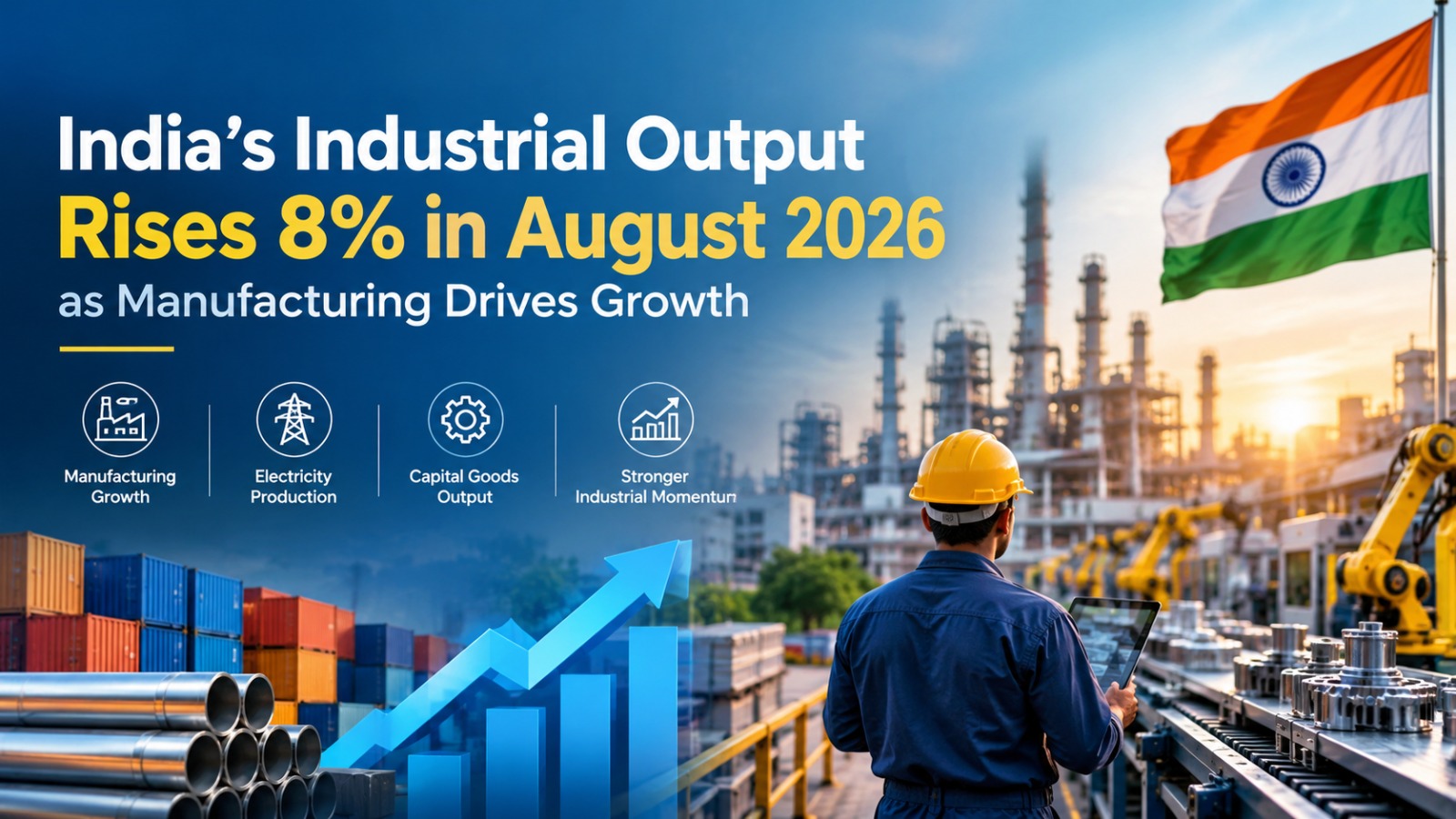
India Industrial Output Rises 8% in August 2026
India’s industrial output grew 8% in August 2026, led by strong manufacturing and electricity production. Explore the key trends shaping India’s industrial growth.
India’s industrial sector continued to gain momentum in August 2026, with overall industrial output rising 8% year-on-year, according to data reported on September 28. The growth was significantly above economists’ expectation of around 6.5%, highlighting stronger activity across several major parts of the economy.
Manufacturing remained the key driver of this expansion, while electricity generation also recorded substantial growth. The latest figures provide an important indicator of the strength of India’s industrial activity as businesses continue to expand production and investment.
Manufacturing Emerges as a Major Growth Driver
Manufacturing output increased 9% year-on-year in August, accelerating from 8.2% growth in July. This marked the third consecutive month in which manufacturing growth remained above 8%.
The sustained performance indicates continued demand for manufactured goods and expanding production activity across several industries.
India’s manufacturing ecosystem has also been supported by investments in electronics, semiconductors, renewable energy, automobiles and other strategic sectors. A recent Jefferies report identified space, semiconductors, data centres, electronics, solar manufacturing and aerospace as sectors contributing to the country’s next industrial investment cycle.
Electricity Production Adds to Industrial Momentum
Electricity generation increased 12.3% in August, compared with 8.7% growth in July. Rising electricity production generally reflects increased industrial and commercial activity, although electricity demand is also influenced by weather and other factors.
The strong performance of the electricity sector therefore provides another important data point for understanding the broader industrial environment.
Capital Goods Output Remains Strong
Capital goods production, an important indicator of investment activity, increased 16.9% in August 2026. Although this was slightly below the 19% growth recorded in July, the double-digit expansion continued to point toward strong investment-related activity.
Growth in capital goods can be particularly significant because it reflects demand for machinery and equipment used by businesses to expand or modernise their production capabilities.
Consumer Goods Sector Shows Mixed Performance
Consumer-oriented industries also recorded growth during the month.
Consumer durables production increased 11.1%, following 12% growth in July. Meanwhile, consumer non-durables grew 2.1% in August after contracting 0.8% in July.
The difference between the two segments suggests that consumer demand is not moving uniformly across all categories. Durable goods, including products such as automobiles and electronic devices, continued to show relatively strong production growth.
Mining Remains a Weak Spot
Despite the overall improvement in industrial production, mining remained under pressure.
Mining activity declined 5.6% year-on-year in August, compared with a smaller 0.9% decline in July. This represents one of the major contrasts within the latest industrial data.
The contraction means that manufacturing and electricity were responsible for much of the overall industrial momentum during the month.
India’s Industrial Growth in the First Five Months of FY2026–27
Looking beyond a single month, cumulative industrial output between April and August 2026 increased 6.7%, compared with 4.2% during the corresponding period of the previous year.
The broader five-month trend is important because it reduces the impact of monthly fluctuations and provides a clearer picture of industrial performance during the current financial year.
Emerging Industries Could Support the Next Investment Cycle
India’s industrial expansion is increasingly extending beyond traditional manufacturing.
Recent industry analysis has highlighted semiconductors, electronics, solar manufacturing, aerospace, space technology and data centres as emerging areas of investment. Government incentives, private-sector participation and efforts to strengthen domestic supply chains are supporting development across these sectors.
For example, India’s semiconductor ecosystem has attracted significant planned investment, while electronics manufacturing has become an increasingly important part of the country’s industrial strategy.
The government’s Production-Linked Incentive programme has also supported manufacturing activity. By September 2026, large-scale electronics manufacturers had received more than ₹19,090 crore in PLI incentives, while investments in the sector exceeded ₹20,580 crore, according to data cited from the Department for Promotion of Industry and Internal Trade.
What the Latest Industrial Data Means for Businesses
The August industrial figures provide several important signals for businesses and investors.
First, manufacturing continues to be a major contributor to India's economic activity. Second, strong capital goods growth indicates continued demand for machinery and industrial investment. Third, emerging technology-intensive sectors are creating new opportunities across manufacturing, infrastructure and services.
However, the contraction in mining demonstrates that industrial growth remains uneven across sectors. Businesses therefore need to consider differences in input costs, supply chains, energy availability and domestic and international demand when evaluating future expansion.
India’s Manufacturing Sector Enters an Important Phase
India’s latest industrial production figures show that manufacturing momentum remained strong in August 2026. With industrial output growing 8% and manufacturing expanding 9%, the data points to continued strength in production activity.
At the same time, investments in electronics, semiconductors, renewable energy, aerospace and other emerging industries are reshaping India’s industrial landscape.
The combination of manufacturing expansion, capital investment and emerging technology sectors could make industrial development an important theme for businesses and policymakers as India moves through FY2026–27.
Disclaimer: This article is for informational purposes and is based on publicly reported industry data available as of September 29, 2026.
To read more such news visit Startup Times.


Leave a comment
Your email address will not be published. Required fields are marked *
Add a newsletter to your widget area.
Top Stories