
TCS Q2 Results 2026: Profit Rises 15% as AI Demand Grows
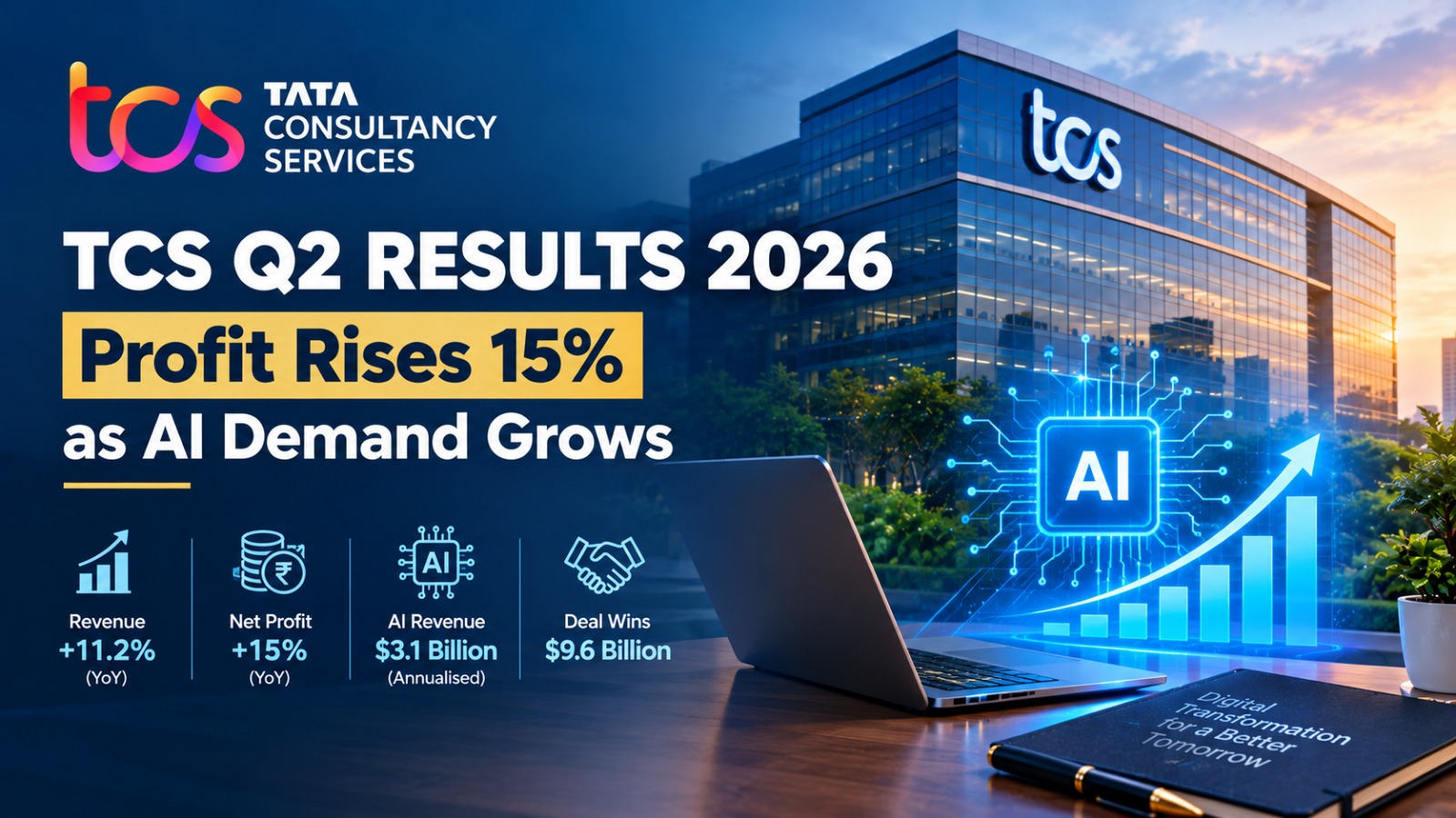
TCS Q2 Results 2026 show a 15% rise in net profit and 11.2% revenue growth as AI services and banking technology drive business performance.
TCS Q2 Results 2026 have highlighted the growing influence of artificial intelligence on India's information technology industry. Tata Consultancy Services (TCS), one of India's largest IT services companies, reported higher revenue and net profit for the July–September quarter, supported by demand for AI-related services and steady business in the banking and financial services sector.
According to a Reuters report published on October 8, 2026, TCS recorded consolidated revenue of ₹73,188 crore for the September quarter, representing an 11.2% year-on-year increase. Net profit rose 15% to ₹13,884 crore, slightly exceeding analysts' expectations.
The results offer an important indication of how India's technology services industry is adapting to changing client priorities, particularly as businesses increase their investments in artificial intelligence, automation, and digital transformation. However, slower sequential revenue growth and pressure on operating margins suggest that the industry continues to face significant challenges.
TCS Q2 Results 2026: Key Financial Highlights
TCS delivered positive year-on-year growth during the second quarter of the 2026–27 financial year.
The company's performance reflected higher revenue, improved net profit, and increasing demand for AI-related services.
Here are the key figures reported for the September 2026 quarter:
- Consolidated revenue: ₹73,188 crore.
- Year-on-year revenue growth: 11.2%.
- Net profit: ₹13,884 crore.
- Year-on-year net profit growth: 15%.
- Annualised AI revenue: $3.1 billion.
- Quarterly deal wins: $9.6 billion.
- Operating margin: 24.2%.
The financial figures indicate that TCS continued to expand its business compared with the corresponding quarter last year. However, the company also experienced slower sequential revenue growth and a decline in its operating margin.
Artificial Intelligence Becomes an Important Growth Driver
Artificial intelligence is increasingly influencing how technology services companies develop products, deliver projects, and generate revenue.
TCS has been expanding its AI-related services as businesses look for ways to improve productivity, automate processes, and modernise their technology infrastructure.
During the September quarter, TCS reported annualised AI revenue of $3.1 billion, up from $2.6 billion in the previous quarter.
This increase highlights the growing commercial importance of AI services within the company's business.
Organisations across industries are exploring applications such as intelligent customer support, software development assistance, predictive analytics, document processing, and automated business workflows.
For IT services providers, these developments create opportunities to offer new solutions and help customers integrate AI into existing systems.
However, the transition also requires investment in employee skills, infrastructure, cybersecurity, and new delivery models.
Why AI Demand Matters for TCS
TCS operates in a competitive global technology services market in which businesses increasingly expect measurable outcomes from technology investments.
AI-related projects could allow the company to support clients with productivity improvements, process automation, and the development of new digital capabilities.
As organisations move from experimenting with AI to deploying it in their daily operations, demand may emerge for implementation, integration, consulting, and ongoing support services.
At the same time, AI could change the economics of traditional IT outsourcing.
Some projects that previously required large teams and lengthy development cycles may become more efficient through automation. This could put pressure on conventional billing models while creating demand for more specialised AI services.
Consequently, the long-term impact of AI will depend on how effectively IT companies adapt their offerings, workforce capabilities, and pricing strategies.
Banking and Financial Services Support Business Performance
The banking and financial services segment remains an important part of TCS's business.
According to Reuters, this vertical accounts for approximately one-third of the company's revenue. Revenue from the segment increased by 3.9% year-on-year, excluding currency fluctuations, during the September quarter.
Banks and financial institutions continue to invest in digital infrastructure, cloud computing, cybersecurity, data analytics, and modernisation of legacy systems.
These investments create opportunities for technology providers that can help financial institutions improve operational efficiency and deliver digital services.
For TCS, demand from banking clients provides an important source of business, although growth rates can vary depending on customer spending priorities and economic conditions.
Financial institutions are also examining how AI can support fraud detection, customer service, risk assessment, and internal operations.
However, these applications require appropriate safeguards because financial services involve sensitive information, regulatory obligations, and decisions that can significantly affect customers.
Deal Wins Reach $9.6 Billion
TCS reported quarterly deal wins worth $9.6 billion during the September quarter.
The figure was slightly higher than the $9.5 billion recorded in the preceding quarter but below the $10 billion reported in the corresponding period a year earlier.
Deal wins are an important indicator of customer demand and potential future business. However, the value of contracts signed during a quarter does not translate immediately into recognised revenue.
The timing of project execution, customer spending, contract duration, and implementation requirements can influence when these deals contribute to financial results.
For investors and industry observers, the combination of deal wins and actual revenue growth provides a more complete picture of business performance than either measure alone.
TCS's latest figures suggest that demand remains present, although the company continues to operate in a market where customers carefully evaluate technology spending and expected returns.
Operating Margins Face Pressure
Despite stronger year-on-year revenue and profit, TCS experienced pressure on its operating margin.
The company's operating margin declined by 120 basis points to 24.2%, with higher wages contributing to the pressure.
Operating margins matter because they show how much revenue a company retains from its core operations before accounting for certain non-operating items.
For a large IT services provider, margins can be affected by employee compensation, utilisation rates, project costs, pricing, currency movements, and investments in new capabilities.
The expansion of AI services may create opportunities to improve productivity, but the financial benefits depend on how those efficiencies are captured and whether customers expect lower prices as a result.
Companies must also invest in training employees and developing new technical capabilities to remain competitive.
For TCS, maintaining profitability while investing in AI and responding to changing customer requirements will remain an important business priority.
Slower Sequential Growth Raises Questions
Although TCS delivered double-digit year-on-year revenue growth, its sequential performance was more subdued.
Revenue growth excluding currency fluctuations was 0.5% compared with the preceding quarter, the lowest sequential growth for a July–September quarter in three years, according to Reuters.
This difference between year-on-year and sequential growth is important.
Year-on-year comparisons measure performance against the same period in the previous year, while sequential comparisons show changes from the immediately preceding quarter.
A company can report strong annual growth while experiencing slower momentum in the most recent quarter.
For TCS, the latest results suggest that AI-related demand is supporting the business, but broader growth remains uneven.
Future performance will depend on client spending, new contract execution, the adoption of AI solutions, and the wider economic environment.
What TCS's Results Mean for India's IT Industry
TCS is among the first major Indian IT services companies to announce results in the current quarterly earnings season.
Its performance provides an early indication of the business conditions facing the wider technology services industry.
Other major Indian IT companies, including Infosys, HCLTech, Wipro, and Tech Mahindra, are scheduled to report their results in the coming weeks.
Market participants will be watching revenue growth, operating margins, deal wins, and management commentary about client spending.
AI is likely to remain a central theme in these discussions because it presents both an opportunity for new business and a challenge to traditional IT services models.
Companies that develop strong AI capabilities, establish customer trust, and deliver measurable business value could be better positioned to benefit from the industry's transformation.
However, the speed at which customers adopt AI at scale remains an important variable.
Businesses may continue to test AI solutions before committing to large deployments, while concerns about data security, reliability, compliance, and implementation costs could influence adoption.
Opportunities for Startups and Technology Businesses
The growing use of AI by large IT services companies also has implications for startups and smaller technology businesses.
Entrepreneurs can explore opportunities in specialised software, automation, industry-specific AI tools, cybersecurity, data management, and enterprise integration.
Rather than competing directly with large technology providers across every category, startups may find opportunities by addressing specific business problems.
For example, a small company could develop AI tools for customer support, document processing, sales operations, or data analysis for a particular industry.
The commercial potential of these products will depend on whether they solve genuine customer problems, integrate with existing systems, and deliver measurable results.
The broader lesson from TCS's performance is that AI is becoming an increasingly important part of the technology services market. Businesses of different sizes will need to understand how the technology can improve their operations while managing its limitations.
What to Watch in the Coming Quarters
Several factors will help determine the future performance of TCS and the wider Indian IT industry.
AI revenue growth: Investors will monitor whether AI-related services continue to expand and how much they contribute to overall business performance.
Client spending: Technology budgets and demand for consulting, cloud, and software services will influence new contract activity.
Operating margins: Wage costs, productivity improvements, pricing, and investments in new capabilities will affect profitability.
Deal conversion: The speed at which signed contracts translate into revenue will remain important.
Competition: IT services companies will need to differentiate their offerings as more businesses invest in AI and automation.
These indicators will help show whether the current increase in AI demand can support sustained business growth.
Conclusion
The TCS Q2 Results 2026 demonstrate the growing importance of artificial intelligence in India's technology services industry.
The company reported an 11.2% year-on-year increase in revenue and a 15% rise in net profit for the September quarter. Annualised AI revenue also increased to $3.1 billion, highlighting the expanding commercial role of AI-related services.
Nevertheless, slower sequential growth and pressure on operating margins show that the transition is not without challenges.
For TCS, the coming quarters will be important in determining how effectively the company converts AI demand into sustainable revenue and profitability.
For India's wider IT sector, the results reinforce a significant trend: artificial intelligence is changing not only the services technology companies provide but also how those services are delivered and priced.
As businesses continue to invest in digital transformation, the companies that combine technological innovation with strong execution and measurable customer value may be best positioned to benefit.
To Read More Such News Visit Startup Times .

Leave a comment
Your email address will not be published. Required fields are marked *
Add a newsletter to your widget area.
Top Stories