
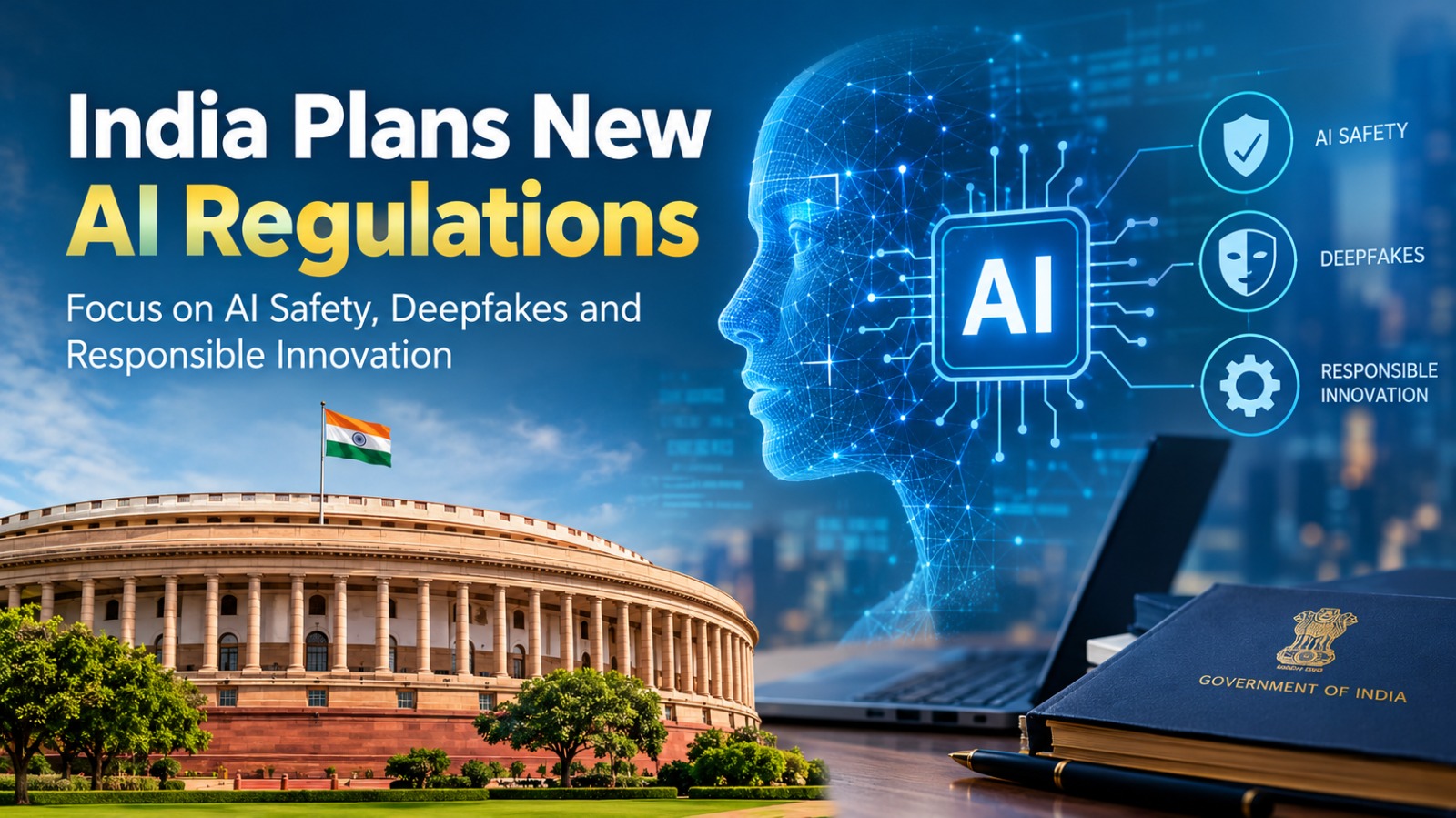
India AI Regulation 2026: Government Plans New Rules
India plans a new AI regulation framework focused on AI safety, deepfakes, responsible innovation, and the future of artificial intelligence.
India AI Regulation 2026 has emerged as an important technology policy development after Union Information Technology Minister Ashwini Vaishnaw announced on October 8 that the government plans to release a consultation paper on artificial intelligence within the next month. The proposed consultation marks a significant step towards a broader discussion on AI governance, safety, and responsible technological development in India.
The announcement comes as artificial intelligence becomes increasingly integrated into businesses, digital communication, content creation, customer service, and other industries. While AI technologies offer opportunities for innovation and productivity, their growing capabilities have also raised concerns about deepfakes, misinformation, security risks, and the potential consequences of autonomous AI systems.
The upcoming consultation is expected to help stakeholders examine these challenges and discuss how India can encourage technological innovation while addressing emerging risks.
India Plans a New Artificial Intelligence Consultation Framework
On October 8, 2026, Information Technology Minister Ashwini Vaishnaw indicated that the government was moving towards a more comprehensive approach to artificial intelligence regulation.
According to reporting by The Indian Express, the proposed consultation will focus primarily on AI safety, with attention to the wider effects of artificial intelligence on society.
The government has also highlighted the importance of inclusive development and skills training to ensure that AI-driven changes do not leave sections of the population behind.
The consultation paper is expected to provide a basis for examining different regulatory approaches and gathering views on how AI systems should be developed and deployed.
However, the announcement does not mean that a complete new AI law has already been introduced. The consultation process is an important preliminary step towards discussing potential rules and policy measures.
Why Does India Need AI Regulation?
Artificial intelligence is developing rapidly, and its applications now extend well beyond conventional software.
Businesses use AI tools to analyse information, automate repetitive tasks, generate content, improve customer experiences, and support decision-making. At the same time, the technology can be misused to create convincing fake videos, manipulate audio recordings, and distribute misleading information.
These developments have increased the need for clear policies that address the potential risks of AI without unnecessarily restricting useful innovation.
Several issues are becoming particularly important in discussions about AI regulation.
1. The Growing Threat of Deepfakes
Deepfakes are digitally manipulated or AI-generated videos, images, and audio recordings designed to resemble real people or events.
As these tools improve, distinguishing authentic content from fabricated material can become increasingly difficult.
Deepfakes may be used to spread false information, impersonate public figures, damage reputations, or deceive individuals and organisations.
The Indian government's proposed consultation will examine the risks associated with deepfakes and other potential harms linked to artificial intelligence.
A stronger framework could encourage discussions about identifying synthetic content, establishing accountability, and protecting individuals from malicious manipulation.
2. AI Safety and Security
AI systems can create risks when they produce unreliable information, operate without adequate oversight, or are used in harmful ways.
As businesses increasingly rely on automated systems, questions about security, reliability, and human supervision become more important.
For example, an organisation using AI to process customer information must consider data protection, access controls, and the possibility of incorrect outputs.
Similarly, businesses deploying AI for important operational decisions need appropriate safeguards and human oversight.
India's consultation could provide an opportunity to explore how organisations should evaluate and manage these risks.
3. Accountability for AI-Generated Content
Another important question concerns responsibility when an AI system generates harmful or misleading material.
AI products may involve multiple participants, including developers, technology providers, businesses, and end users. Determining responsibility can become complicated when an output is generated automatically.
According to The Indian Express, potential issues under discussion include liability for AI-generated outputs and the legal protections that should apply to AI platforms and developers.
Clearer rules could help businesses understand their responsibilities and give users a better understanding of the protections available to them.
Nevertheless, the specific legal obligations that may eventually emerge remain uncertain.
What Could AI Regulation Mean for Indian Startups?
India's startup ecosystem has increasingly adopted artificial intelligence across industries such as fintech, education, healthcare, marketing, customer service, and enterprise software.
AI tools allow smaller companies to automate operations, develop new products, and compete in markets that previously required larger teams and substantial resources.
However, changes in AI governance could also influence how startups build and deploy their products.
Greater Attention to Responsible AI Development
Startups developing AI-powered applications may need to pay closer attention to product safety, data handling, transparency, and human oversight as regulatory expectations evolve.
Companies that build these considerations into their products early could be better positioned to respond to future compliance requirements.
For example, a startup developing an AI customer support platform could evaluate how its system handles sensitive information, communicates uncertainty, and escalates complex issues to human employees.
These practices can help businesses build customer confidence even before specific new requirements are finalised.
Opportunities for AI Safety Startups
Regulatory discussions may also create opportunities for companies developing technologies that help businesses manage AI-related risks.
Potential areas of innovation include:
- Deepfake detection and synthetic media verification.
- AI security testing and risk assessment.
- Systems for monitoring AI-generated content.
- Data privacy and governance software.
- Tools for evaluating AI accuracy and reliability.
- Solutions for documenting AI usage and managing compliance.
These are potential business opportunities rather than confirmed outcomes of the government's announcement.
For entrepreneurs, the broader lesson is that the growth of AI may create demand not only for AI-powered products but also for tools that make those products safer and more trustworthy.
The Importance of Balancing Innovation and Compliance
Startups often operate with limited financial and technical resources. Complex regulatory requirements could increase their development and compliance costs.
At the same time, unclear rules can make it difficult for founders to determine how to launch products responsibly.
A well-designed regulatory framework could help establish clearer expectations while allowing room for experimentation and innovation.
The challenge for policymakers will be to address genuine risks without creating unnecessary barriers for early-stage companies.
How Could AI Regulation Affect Businesses and Consumers?
The potential impact of India's AI policy discussions extends beyond technology companies.
Businesses across sectors are adopting AI for marketing, recruitment, analytics, financial operations, and customer engagement. As adoption grows, organisations may need to review how they use these systems and how they communicate AI-generated information.
Implications for Businesses
Companies using AI may benefit from reviewing their existing practices, particularly in areas involving customer data, automated decisions, and externally published content.
Practical steps include:
- Review AI usage: Identify where AI tools are being used across business operations.
- Protect sensitive information: Establish appropriate safeguards for confidential and customer data.
- Maintain human oversight: Review important AI-generated outputs before acting on them.
- Improve transparency: Make it clear when users are interacting with AI where appropriate.
- Monitor policy developments: Follow official announcements as the consultation process progresses.
These measures can help organisations prepare for evolving expectations without assuming that proposed rules have already become mandatory.
Implications for Consumers
Consumers increasingly encounter AI-generated content on social media, websites, messaging platforms, and digital services.
Greater attention to AI safety could contribute to discussions about online authenticity, consumer protection, and accountability.
However, regulation alone cannot eliminate every form of digital misinformation. Public awareness, independent verification, responsible technology design, and appropriate enforcement will also remain important.
Consumers should continue verifying surprising claims and checking reliable sources before sharing potentially misleading content.
What About Advanced and Autonomous AI Systems?
Another important aspect of the AI policy discussion is the development of increasingly capable systems that can perform tasks with limited human intervention.
These systems, sometimes described as agentic AI, can use tools and carry out sequences of actions towards a specified objective.
For businesses, such systems may support workflows such as research, customer service, scheduling, and operational coordination.
However, greater autonomy also raises questions about supervision, reliability, and responsibility when something goes wrong.
The consultation will examine risks associated with advanced AI applications, including agentic systems.
Possible policy questions include how much autonomy a system should have in high-risk situations, when human approval should be required, and who should be responsible for harmful outcomes.
The final approach will depend on the policy process and the rules, if any, that are ultimately introduced.
India's AI Policy: What Happens Next?
The immediate next step announced by the government is the planned release of an AI consultation paper within a month of October 8, 2026.
The consultation is expected to help frame discussions around AI safety, deepfakes, inclusive development, and the responsibilities of companies building and deploying artificial intelligence systems.
For businesses, startups, technology professionals, and researchers, the process will be worth following because the resulting policy direction could influence India's developing AI ecosystem.
However, several details remain unresolved.
These include the precise scope of any future regulatory framework, the responsibilities that may apply to different AI stakeholders, and whether additional legal or technical requirements will be introduced.
Until the government publishes further details, businesses should distinguish between announced policy plans, proposals under consultation, and rules that are formally adopted.
Conclusion
India AI Regulation 2026 marks an important development in the country's ongoing discussion about artificial intelligence, digital safety, and responsible innovation.
The government's planned consultation paper reflects growing attention to the risks associated with deepfakes, increasingly capable AI systems, and accountability for AI-generated outputs.
For Indian startups and established businesses, the development presents both challenges and opportunities. Organisations may need to strengthen their AI governance practices, while entrepreneurs could find new opportunities in safety, verification, privacy, and compliance technologies.
The immediate focus should remain on the consultation process and the government's subsequent announcements. The final impact on India's technology industry will depend on how the proposed approach develops and what measures are ultimately implemented.
As AI adoption continues to expand, balancing innovation with safety will remain an important challenge for India's digital economy.
To Read More Such News Visit Startup Times .

Leave a comment
Your email address will not be published. Required fields are marked *
Add a newsletter to your widget area.
Top Stories