
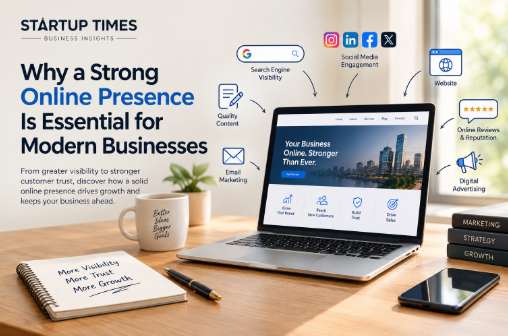
Why a Strong Online Presence Is Essential for Modern Businesses
A strong online presence helps modern businesses increase visibility, build customer trust, reach wider audiences, and drive sustainable growth. From websites and SEO to social media and digital content, businesses can use digital channels to connect with customers and stay competitive.
In today’s digital-first business environment, having a strong online presence is no longer optional. Whether it is a startup, small business, D2C brand, professional service, or established company, customers increasingly use digital platforms to discover businesses, research products, compare options, read reviews, and make purchasing decisions.
A strong online presence helps businesses become more visible, build credibility, communicate with customers, and create opportunities for sustainable growth. It goes beyond simply having a website or social media account. It includes everything customers can find about a business online, from its website and social media profiles to search results, reviews, content, and digital customer interactions.
For modern businesses, building this presence strategically can make it easier to reach the right audience and stay competitive in an increasingly crowded marketplace.
What Is an Online Presence?
An online presence refers to how a business appears and interacts across the internet. It includes all the digital channels through which potential customers can discover or engage with a company.
Some important elements of an online presence include:
- A professional business website
- Search engine visibility
- Social media profiles
- Online reviews and ratings
- Business listings
- Blogs and educational content
- Email marketing
- Digital advertising
- Customer reviews and testimonials
- Online communities and discussions
These elements work together to shape how people perceive a business.
For example, a customer searching for a service may first discover a company through Google, visit its website, check its social media pages, read customer reviews, and then contact the business. Every one of these touchpoints contributes to the company's online presence.
1. Helps Customers Discover Your Business
One of the biggest advantages of having a strong online presence is improved discoverability.
Consumers often turn to search engines and social media when looking for products, services, or information. If a business does not have sufficient digital visibility, potential customers may struggle to find it.
Search engine optimization (SEO), useful content, social media activity, and a well-structured website can help businesses appear in front of relevant audiences.
For example, a local bakery can optimize its website for searches related to cakes, custom cakes, or bakeries in its city. Similarly, a B2B software company can create informative content around the problems its product solves.
The goal is not simply to generate more traffic. It is to make the business discoverable when potential customers are actively looking for relevant solutions.
2. Builds Business Credibility and Trust
Customers want to know whether a business is reliable before spending their money.
A professional website, active social media presence, transparent information, customer reviews, and useful content can help establish credibility.
Imagine two businesses offering similar services. One has a professional website with clear service information, customer testimonials, contact details, and regularly updated content. The other has very little information available online.
Even if both businesses offer quality services, customers may feel more comfortable researching the business that provides clear and accessible information online.
An online presence does not automatically guarantee trust. However, consistent and transparent digital communication can give customers more information to evaluate a business.
3. Creates Opportunities to Reach a Wider Audience
Traditional business models can sometimes limit companies to specific geographic areas. Digital platforms allow businesses to communicate with audiences beyond their immediate location.
A small business can use social media, search engines, content marketing, and online marketplaces to reach customers across different cities or even countries.
For example, a small Indian D2C brand can use its website and social media platforms to showcase products to customers across multiple states instead of depending entirely on local foot traffic.
This wider reach can create new opportunities for customer acquisition and business expansion.
4. Strengthens Brand Awareness
Building a recognizable brand requires consistency.
A strong online presence allows businesses to repeatedly communicate their identity, values, products, and expertise through different digital channels.
Website design, social media content, visual identity, tone of communication, blogs, videos, and customer interactions all contribute to brand perception.
For startups in particular, consistent online communication can help them establish recognition even when competing against larger and more established companies.
A business does not necessarily need to publish content on every platform. Instead, it should focus on the channels where its target audience is most active and maintain a consistent brand experience across them.
5. Makes Customer Communication Easier
Modern customers often expect businesses to be accessible online.
Websites, social media, email, chat platforms, and messaging applications provide multiple ways for customers to ask questions, request information, provide feedback, or seek support.
This can make communication faster and more convenient.
Businesses can also use frequently asked questions, knowledge bases, blogs, tutorials, and short-form videos to answer common customer questions before a customer even contacts the company.
Better digital communication can improve the overall customer experience while reducing repetitive questions for business teams.
6. Supports Digital Marketing Strategies
A strong online presence provides a foundation for digital marketing.
Businesses can combine several strategies, including:
- Search engine optimization
- Content marketing
- Social media marketing
- Email marketing
- Influencer marketing
- Paid advertising
- Video marketing
- Affiliate marketing
For example, a company may publish an SEO-focused blog to attract organic traffic, use Instagram to build brand awareness, run paid advertisements to reach specific audiences, and use email marketing to nurture existing customers.
The effectiveness of each channel can vary depending on the industry, audience, offer, and business objectives. This is why businesses should measure performance instead of relying only on visibility metrics such as followers or impressions.
7. Provides Valuable Customer Insights
Digital platforms can provide businesses with useful information about customer behaviour.
Website analytics can show which pages receive the most traffic, how visitors find the website, and where they leave. Social media analytics can provide information about content engagement and audience responses.
Customer reviews and comments can also reveal common concerns, preferences, and expectations.
Businesses can use these insights to improve their products, content, customer experience, and marketing strategies.
For example, if customers repeatedly ask the same question about a product, a company could create a dedicated FAQ section or explanatory video.
In this way, an online presence can become more than a marketing tool. It can also support business decision-making.
8. Helps Businesses Compete in Crowded Markets
Competition exists in almost every industry.
For smaller businesses, competing with established companies can be challenging because larger brands may have greater resources and stronger recognition.
A well-planned online presence can help smaller businesses communicate their unique value proposition and reach specific customer segments.
Instead of trying to appeal to everyone, a business can focus on a clearly defined audience and communicate why its product or service is relevant to that audience.
Niche positioning, useful content, strong customer relationships, and consistent branding can help businesses differentiate themselves online.
9. Supports Customer Retention and Loyalty
Online presence is not only about attracting new customers.
Businesses can also use digital channels to maintain relationships with existing customers.
Email newsletters, social media communities, loyalty programs, educational content, product updates, and personalized communication can keep customers engaged after a purchase.
For example, a skincare brand could share educational content about product usage, skincare routines, and common customer questions. This provides value beyond the initial transaction.
When businesses consistently provide useful experiences, they can create more opportunities for repeat engagement.
10. Makes the Business Available Around the Clock
A physical store may have fixed operating hours, but a website and digital content can remain accessible at any time.
Potential customers can visit a website, explore products, read blogs, check FAQs, view testimonials, or submit an inquiry even outside normal business hours.
This does not mean businesses must provide 24/7 human support. Instead, a well-designed digital presence can provide customers with useful information whenever they need it.
This can be particularly valuable for businesses serving customers across different cities or time zones.
11. Helps Generate and Nurture Leads
For many businesses, the online journey does not immediately end with a purchase.
A visitor may discover a brand today but make a purchase weeks later.
Businesses can use landing pages, downloadable resources, email newsletters, remarketing campaigns, webinars, and educational content to stay connected with potential customers.
This creates opportunities to move prospects through different stages of the customer journey.
For B2B businesses, this can be particularly important because purchasing decisions may involve multiple people and take longer to complete.
A strong online presence can therefore support both immediate conversions and longer-term lead nurturing.
12. Supports Business Growth in a Changing Market
Consumer behaviour continues to evolve.
New platforms, technologies, search behaviours, content formats, and digital tools continue to influence how people interact with businesses.
Companies that regularly evaluate their digital presence can respond more effectively to these changes.
This does not mean businesses need to follow every digital trend. Instead, they should understand where their customers are spending time and how their behaviour is changing.
A flexible online strategy allows businesses to test new channels, analyze results, and adjust their approach when necessary.
How Businesses Can Build a Strong Online Presence
Creating an online presence does not require being active everywhere. Businesses should focus on building a strong foundation first.
Build a Professional Website
A website should clearly explain what the business offers, who it serves, and how customers can take the next step.
Important elements include:
- Clear navigation
- Mobile-friendly design
- Fast-loading pages
- Relevant content
- Clear calls to action
- Contact information
- Product or service details
- Customer reviews where appropriate
Invest in SEO
SEO can improve a business's ability to appear in relevant search results.
Businesses should research the keywords their target customers use and create useful content around those topics.
On-page elements such as titles, headings, URLs, meta descriptions, internal links, and content structure should also be optimized appropriately.
Choose the Right Social Media Platforms
Businesses do not need to maintain every social media account.
Instead, they should identify platforms that align with their target audience and business goals.
A fashion brand may prioritize Instagram and short-form video platforms, while a B2B company may find professional networking platforms more relevant.
Create Useful Content
Content should provide value rather than simply promote products.
Businesses can create:
- Blog articles
- Educational videos
- Guides
- Case studies
- FAQs
- Infographics
- Customer stories
- Product demonstrations
Useful content can help businesses demonstrate expertise while answering questions customers already have.
Monitor Reviews and Feedback
Businesses should regularly monitor customer reviews and online feedback.
Responding professionally to questions and concerns can demonstrate that the company values customer experience.
Feedback can also provide insights that help businesses improve their products and services.
Common Mistakes Businesses Should Avoid
Building an online presence requires consistency and strategy. Some common mistakes include:
Being active on too many platforms: Managing several platforms without enough resources can lead to inconsistent content.
Ignoring mobile users: A significant portion of digital activity takes place on smartphones, making mobile-friendly experiences important.
Focusing only on followers: A large follower count does not necessarily translate into customers or revenue.
Publishing without a strategy: Random content may generate activity without supporting business objectives.
Ignoring negative feedback: Avoiding customer concerns can damage trust. Businesses should respond professionally and look for opportunities to resolve genuine issues.
Failing to measure results: Businesses should track relevant metrics such as website traffic, leads, engagement, conversion rates, and customer retention depending on their objectives.
The Future of Business Is Increasingly Digital
A strong online presence has become an important part of how modern businesses communicate, compete, and grow.
From helping customers discover a company to building credibility, generating leads, collecting feedback, and maintaining customer relationships, digital channels can support multiple stages of the business journey.
However, simply being online is not enough. Businesses need a clear strategy, consistent branding, useful content, customer-focused communication, and regular performance analysis.
The most effective online presence is not necessarily the one with the largest audience. It is one that connects a business with the right audience and provides useful information at the right stages of the customer journey.
Conclusion
A strong online presence can give modern businesses more opportunities to be discovered, understood, trusted, and remembered. Whether a company is launching its first product or expanding an established business, digital visibility can play an important role in its growth strategy.
Businesses should begin with the fundamentals: a professional website, clear positioning, relevant SEO, useful content, active customer communication, and a focused social media strategy. From there, they can use analytics and customer feedback to continuously improve their digital approach.


Leave a comment
Your email address will not be published. Required fields are marked *
Add a newsletter to your widget area.
Top Stories