
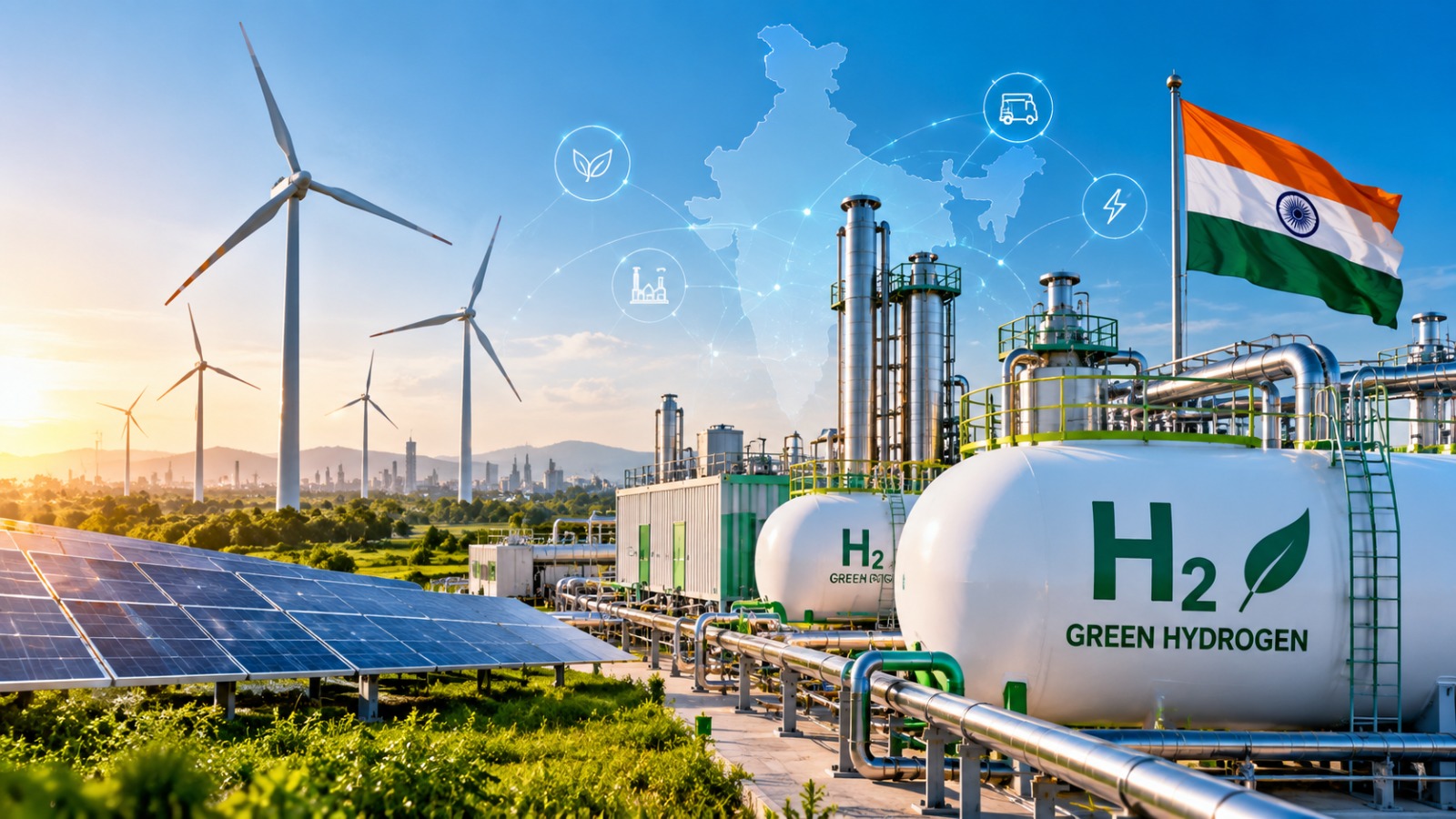
India’s Green Hydrogen Industry: Opportunities and Challenges Ahead
India is building a green hydrogen ecosystem aimed at decarbonising industries, creating new business opportunities and strengthening its clean energy economy.
India is steadily building a new clean-energy industry around green hydrogen, a fuel that could play an important role in reducing emissions from sectors where direct electrification is difficult. Produced by splitting water into hydrogen and oxygen using renewable electricity, green hydrogen can be used in industries such as steel, fertilisers, refining, shipping and heavy transport. For India, the sector is also closely connected to ambitions around energy security, renewable energy expansion and reducing dependence on fossil fuel imports.
The government has placed green hydrogen at the centre of its clean-energy strategy through the National Green Hydrogen Mission, launched in January 2023. The mission has an initial outlay of ₹19,744 crore and aims to develop India as a global hub for the production, use and export of green hydrogen and its derivatives. One of its major targets is to establish at least 5 million metric tonnes per year of green hydrogen production capacity by 2030.
A New Industry Taking Shape
India’s green hydrogen ecosystem is moving beyond policy announcements and into project development, manufacturing and supply-chain creation. Under the mission, incentives are being provided for both electrolyser manufacturing and green hydrogen production. As of March 2026, the government reported that 15 companies had been awarded a combined 3,000 MW per year of electrolyser manufacturing capacity, while 18 companies had been awarded a cumulative green hydrogen production capacity of 8,62,000 tonnes per year.
The development of domestic electrolyser manufacturing is particularly important because electrolysers are one of the key technologies used to produce green hydrogen. Building manufacturing capacity within India could create opportunities across engineering, equipment manufacturing, renewable energy, infrastructure and specialised services. The National Green Hydrogen Mission also includes support for research and development, skill development, pilot projects and the creation of hydrogen hubs, indicating that the emerging industry will require much more than hydrogen production facilities alone.
Where Could Green Hydrogen Be Used?
One of the biggest opportunities for green hydrogen lies in industries that are difficult to decarbonise through conventional renewable electricity alone. Steel manufacturing, fertiliser production, shipping and certain heavy-duty transportation applications are among the areas being explored. Green hydrogen can also be converted into derivatives such as green ammonia, which can be used in the fertiliser industry and potentially in international energy trade.
The government is already working on demand creation. In March 2026, the Ministry of New and Renewable Energy reported that prices had been discovered for the production and supply of 7,24,000 metric tonnes per year of green ammonia to 13 fertiliser units across India. Such initiatives are important because establishing reliable demand is a key part of building a commercially sustainable hydrogen industry.
Opportunities Beyond Hydrogen Production
The growth of the green hydrogen industry could create opportunities across a much wider business ecosystem. Renewable energy developers can supply the electricity required for production, while engineering companies can provide electrolysers, compressors, storage systems, pipelines and other equipment. There is also potential for businesses involved in hydrogen transportation, certification, testing, digital monitoring, safety systems and specialised infrastructure.
The industry could also create demand for skilled professionals in engineering, renewable energy, chemical processing, project management, research and operations. In March 2026, MNRE issued a call for proposals focused on skilling, upskilling and reskilling under the National Green Hydrogen Mission, highlighting the importance of developing the workforce required by the emerging sector.
Building a Hydrogen Infrastructure
Producing green hydrogen is only one part of the challenge. Once produced, hydrogen needs to be stored, transported and delivered to users safely and efficiently. This means India will need infrastructure such as pipelines, specialised transportation systems, storage facilities and distribution networks.
The government’s mission framework specifically includes the development of supply chains and infrastructure for both domestic consumption and exports. Green hydrogen hubs are also being developed as part of the broader strategy, with the aim of bringing production, infrastructure and potential users together in suitable locations.
The Challenges Ahead
Despite the opportunities, the industry still faces several challenges. One of the biggest is cost. Green hydrogen needs to compete with conventional hydrogen production methods, particularly hydrogen produced from fossil fuels. The cost of renewable electricity, electrolyser technology, financing, water and supporting infrastructure can all influence the final cost of hydrogen.
Another challenge is creating sufficient and predictable demand. Large-scale hydrogen projects require significant investment, and companies need confidence that there will be buyers for the hydrogen they produce. Assured demand, supporting infrastructure, project execution and production economics will be important factors influencing the pace of India’s green hydrogen development.
Water availability and infrastructure requirements are also important considerations. Green hydrogen production through electrolysis requires water, while large projects may be located in regions with strong renewable-energy potential but varying water availability. Managing water resources responsibly will therefore remain an important consideration as the industry expands.
Strengthening Trust Through Certification
As the industry develops, proving that hydrogen is genuinely produced using renewable energy will become increasingly important, particularly for international markets. India has been developing certification systems to establish standards for green hydrogen production and support transparency across the sector.
Certification can help establish common standards around how green hydrogen is produced and measured. This could become increasingly relevant as Indian producers look toward international markets and as customers seek greater clarity about the environmental credentials of the hydrogen they purchase.
What Lies Ahead for India?
India’s green hydrogen industry is still developing, but the foundations of a broader ecosystem are being established. Government incentives, electrolyser manufacturing, hydrogen production projects, green ammonia demand, hydrogen hubs, certification systems and skill-development programmes are gradually bringing different parts of the industry together.
The next phase will depend on how effectively these projects move from planned capacity to operational production and whether the industry can bring costs down while developing reliable demand and infrastructure. If these challenges are addressed, green hydrogen could become an important part of India’s industrial and clean-energy transition, while also creating opportunities for manufacturers, energy companies, technology providers, startups and skilled professionals.
India’s green hydrogen story is therefore not simply about replacing one fuel with another. It is about building an entirely new industrial ecosystem around renewable energy, manufacturing, infrastructure, technology and international trade. The decisions made today on investment, technology, standards and infrastructure will shape how this emerging industry develops over the coming decade.
For more insights into India’s emerging industries, business trends, startups and opportunities, visit Startup Times.

Leave a comment
Your email address will not be published. Required fields are marked *
Add a newsletter to your widget area.
Top Stories