
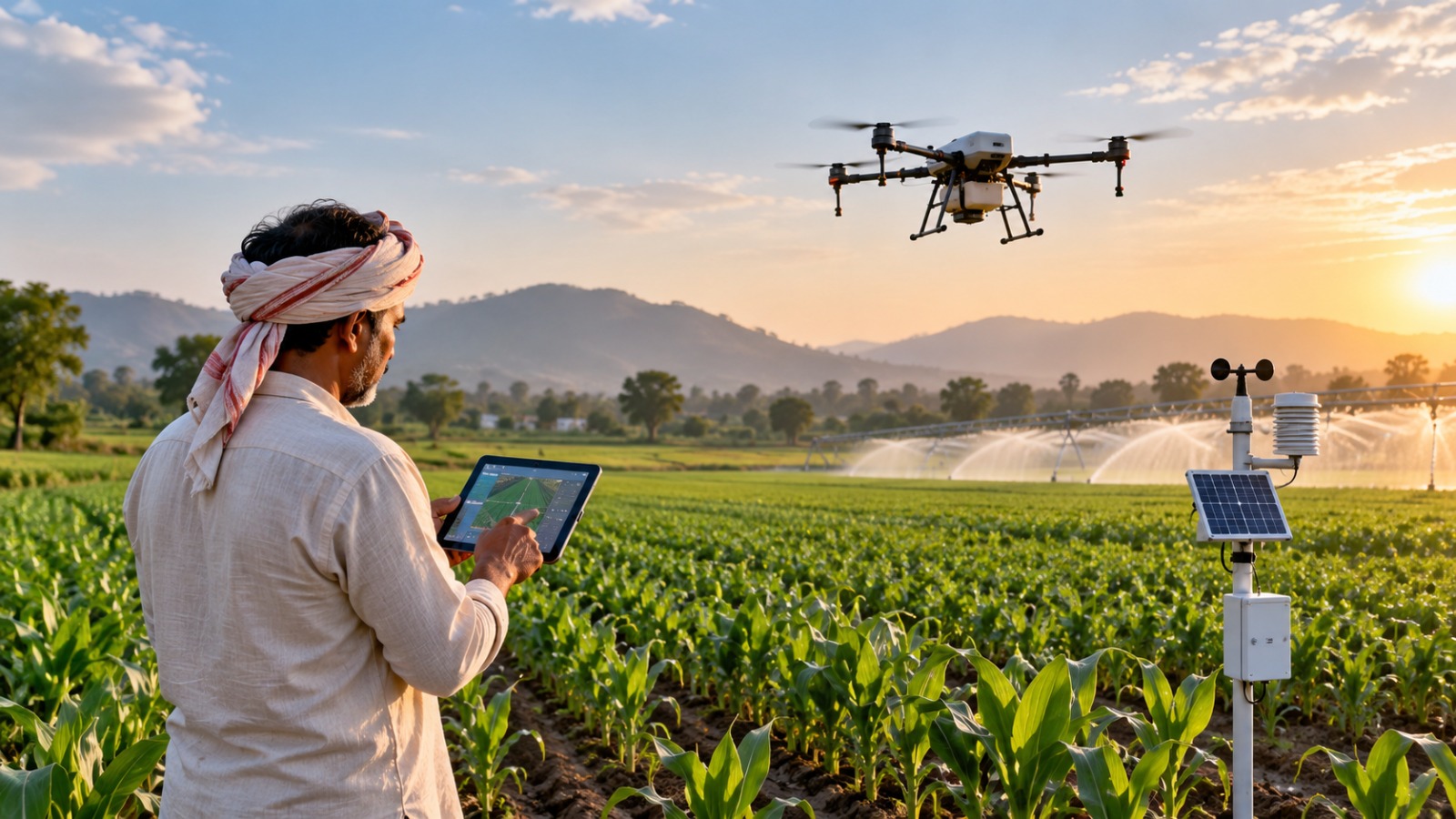
India’s AgriTech Transformation: How Technology Is Changing Farming
India’s agriculture sector is being transformed by AI, drones, IoT, digital platforms and other technologies, creating new opportunities for farmers and AgriTech businesses.
Agriculture has always been closely connected to India’s economy, communities and way of life. But the way farming is done is gradually changing. From farmers using smartphones to access market information to drones monitoring crops and artificial intelligence helping identify pests, technology is becoming an increasingly important part of modern agriculture. This shift is giving rise to a growing AgriTech ecosystem in India, where startups, technology companies, researchers and government institutions are developing solutions for some of the sector’s long-standing challenges.
India’s agricultural landscape is particularly suited to technology-led innovation because the sector operates across a vast and diverse geography. Farmers deal with different soil conditions, weather patterns, crops, water availability and market conditions. At the same time, the average size of an operational agricultural holding was 1.08 hectares according to the Agriculture Census 2015–16, highlighting the importance of solutions that can work effectively for smaller and fragmented farms. Technology cannot eliminate these structural challenges on its own, but it can provide farmers with better information, more efficient tools and new ways to access services and markets.
What Is AgriTech?
AgriTech, short for agricultural technology, refers to the use of technology to improve different stages of agriculture. It goes beyond machinery and includes artificial intelligence, sensors, drones, satellite imagery, Internet of Things devices, mobile applications, digital marketplaces, data analytics, robotics and automated systems.
The objective is not simply to make farms more technologically advanced. The larger goal is to help farmers make better decisions, use resources more efficiently, reduce avoidable losses and improve connections between farms, markets and other parts of the agricultural value chain.
For example, instead of relying only on visual observation to determine whether a crop is under stress, farmers can increasingly use satellite imagery, sensors or digital tools to gather information about soil, weather and crop conditions. Similarly, instead of applying the same amount of water across an entire field, technology can support more targeted irrigation based on the needs of particular areas.
This is the foundation of what is often called precision agriculture: using data and technology to make farming decisions more specific to the crop, soil and location.
From Experience-Based Farming to Data-Driven Decisions
Farmers have traditionally relied heavily on experience and local knowledge. That knowledge remains extremely valuable, but technology is adding another layer of information to the decision-making process.
Weather data can help farmers prepare for changing conditions. Soil information can help determine what crops or nutrients may be appropriate. Satellite and remote-sensing technologies can provide information about crop health across large areas, while sensors can monitor conditions closer to the field.
Artificial intelligence is also beginning to play a role. AI-based systems can process large amounts of agricultural data and identify patterns that may not be immediately visible. In India, government-supported AI initiatives are being used in areas including farmer advisories, pest control, crop identification, insurance and agricultural governance. AI-based pest surveillance systems, for example, can help identify pest-related issues and support timely intervention.
The significance of this shift is that agricultural decisions can increasingly be supported by a combination of human experience and real-time or location-specific information.
Drones Are Taking Agriculture to the Skies
One of the most visible examples of technology entering agriculture is the use of drones.
Agricultural drones can be used for activities such as crop monitoring, surveying fields and applying certain agricultural inputs. Instead of manually inspecting large areas, farmers and agricultural service providers can use aerial imagery to observe crops from above and identify areas that may require attention.
Drones can be particularly useful when combined with other technologies. Images captured from the air can be analysed to identify variations in crop growth or potential problem areas. This can allow agricultural activities to become more targeted rather than treating every part of a field in exactly the same way.
The Indian government has also been promoting modern agricultural technologies including drones, precision farming, artificial intelligence, IoT, robotics, sensors, remote sensing and satellite-based applications as part of the broader push toward technology-enabled agriculture.
The future of agricultural drones may therefore be less about simply flying a machine over a field and more about creating an integrated system in which aerial data, AI and farm-level information work together.
Smart Irrigation and the Importance of Water
Water is one of agriculture’s most important resources, making efficient irrigation a major area for technological innovation.
Traditional irrigation can sometimes result in water being applied without sufficiently considering differences in soil moisture or crop requirements. Smart irrigation systems can use sensors and other data sources to monitor conditions and support more targeted water usage.
This becomes particularly important as agriculture faces increasing pressure from unpredictable weather and changing water availability. Technologies that help farmers understand soil moisture, weather conditions and crop requirements can support more efficient resource management.
The connection between AgriTech and water is also significant because it demonstrates that agricultural technology is not only about increasing production. It can also be about using fewer resources to achieve better outcomes.
Digital Platforms Are Changing Access to Markets
Technology is also changing what happens after crops leave the farm.
Digital platforms can connect farmers with buyers, provide market information and make agricultural transactions more accessible. In India, digital agricultural marketplaces are being developed to improve market integration, price discovery and access to buyers.
The broader opportunity is to make agricultural markets more connected. A smartphone can increasingly become more than a communication device for a farmer; it can serve as a gateway to information about prices, inputs, financial services, government schemes and potential buyers.
This digital connection can also create opportunities for startups that build services around logistics, procurement, farm management, financial technology and supply-chain management.
Building a Digital Infrastructure for Agriculture
India’s AgriTech transformation is not being driven only by private companies. The government is also building digital infrastructure intended to support the wider agricultural ecosystem.
The Digital Agriculture Mission is designed to create a digital public infrastructure for agriculture. Key components include AgriStack, the Krishi Decision Support System and soil profile mapping.
AgriStack is intended to create a digital foundation connecting information about farmers, land and crops. Its structure includes a Farmers Registry, geo-referenced village maps and a Crop Sown Registry. The objective is to make it easier to provide agricultural services and enable access to areas such as credit, insurance, procurement and other farmer-focused services.
The scale of this digital transformation is already significant. Digital farmer identification and crop-survey initiatives are being expanded across states and districts, creating a growing digital foundation for agricultural services.
Such infrastructure can create an important foundation for future AgriTech services because startups and other organisations can potentially develop solutions around reliable agricultural data and digital public infrastructure.
The Rise of AgriTech Startups
As technology becomes more integrated into farming, a new business ecosystem is emerging around it.
AgriTech startups are working across multiple areas, including farm management, agricultural marketplaces, supply chains, financial services, crop monitoring, precision farming, food processing, logistics and climate-smart agriculture.
The opportunity is particularly interesting because agriculture is not a single industry. It is an interconnected ecosystem that includes farmers, input suppliers, equipment manufacturers, financial institutions, traders, food processors, retailers and consumers.
This means that an AgriTech startup does not necessarily have to build a product that sits directly on a farm. A company can create value by solving problems anywhere along this chain.
For example, a technology company could focus on helping farmers understand crop conditions, while another could work on connecting farmers with buyers. Another business could develop logistics technology to reduce delays between farms and markets. Others may focus on agricultural finance, insurance, storage or post-harvest management.
Government initiatives are also supporting the development of agricultural entrepreneurship through financial support and incubation opportunities for agricultural startups. This is helping create an environment where entrepreneurs can experiment with technology-driven solutions for agriculture.
Precision Agriculture Could Change How Farms Are Managed
One of the most important long-term developments in AgriTech is precision agriculture.
Instead of treating an entire farm as one uniform area, precision agriculture uses data to understand differences within fields. Sensors, drones, satellites and AI systems can help monitor soil and crop conditions at a more detailed level.
Research institutions in India are already developing technologies in this area, including sensors, remote sensing through ground, drone and satellite platforms, AI, IoT-based precision farming and monitoring of crop and soil health.
For farmers, the potential benefit is greater precision in decisions about water, nutrients, crop health and other inputs. For businesses, it creates opportunities to develop technologies that turn agricultural data into practical recommendations.
Technology Is Also Creating a New Role for the Farmer
The rise of AgriTech does not necessarily mean that technology replaces farmers. In many cases, its more important role may be to give farmers better tools.
A farmer still understands the land, crop and local environment in ways that a digital system may not. Technology can complement that knowledge by providing additional information and helping process large amounts of data.
This human-technology combination could become one of the defining characteristics of modern agriculture. The farmer remains the decision-maker, while digital tools increasingly act as assistants that provide information, alerts, predictions and recommendations.
Challenges Still Need to Be Addressed
Despite its potential, AgriTech adoption is not without challenges.
Cost remains an important consideration, particularly for smaller farmers. A technology may be technically impressive but have limited impact if farmers cannot afford it or if the economic benefit is unclear.
Digital literacy and connectivity can also affect adoption. Technologies need to be designed around the realities of agricultural communities rather than assuming that every farmer has the same access to smartphones, reliable internet or technical support.
Data is another important issue. As agriculture becomes increasingly digital, questions around data ownership, privacy, security and responsible use become more important. Digital agriculture systems therefore need to balance innovation with safeguards for farmers and their information.
There is also the challenge of making technology practical. A complicated system that requires extensive training may struggle to gain adoption, while a simple solution that directly addresses a farmer’s problem can have much greater value.
The Business Opportunity Ahead
India’s AgriTech opportunity extends far beyond individual technologies. The larger opportunity lies in building an interconnected agricultural ecosystem where data, finance, equipment, advisory services, markets and supply chains work together.
The country’s agricultural scale, diverse crops and regional conditions create a large environment for experimentation and innovation. At the same time, government digital infrastructure is creating new possibilities for technology companies to build farmer-focused services.
The next stage of AgriTech may therefore be less about isolated products and more about integration. A farmer could potentially use a single digital ecosystem to access crop information, weather alerts, market prices, financial services and agricultural recommendations, while data from different sources helps improve the quality of those services.
Artificial intelligence could further accelerate this transformation by helping convert large quantities of agricultural data into more personalised insights. Drones and satellites can provide information from above, sensors can provide information from the field, and digital platforms can connect that information with markets and services.
Looking Ahead
India’s agricultural transformation is unlikely to happen through one technology or one company. It will be shaped by the gradual combination of multiple innovations.
AI can help analyse information. Drones can monitor fields. Sensors can measure soil and environmental conditions. Satellites can provide large-scale observations. Digital platforms can connect farmers to markets. Government digital infrastructure can create new ways of delivering services. Startups can build businesses around these technologies and adapt them to real-world agricultural problems.
The most meaningful measure of AgriTech’s success, however, will not simply be the number of apps, drones or AI systems introduced into agriculture. It will be whether these technologies become affordable, accessible and useful enough to solve genuine problems faced by farmers.
India is already building many of the foundations for a more connected agricultural ecosystem. As technology continues to move from laboratories and pilot projects into fields and supply chains, AgriTech could become an increasingly important part of how the country approaches productivity, resource efficiency, market access and the future of farming.
For more insights into India’s evolving industries, emerging technologies and the startups shaping the future, visit Startup Times and explore more Industry Insights.

Leave a comment
Your email address will not be published. Required fields are marked *
Add a newsletter to your widget area.
Top Stories